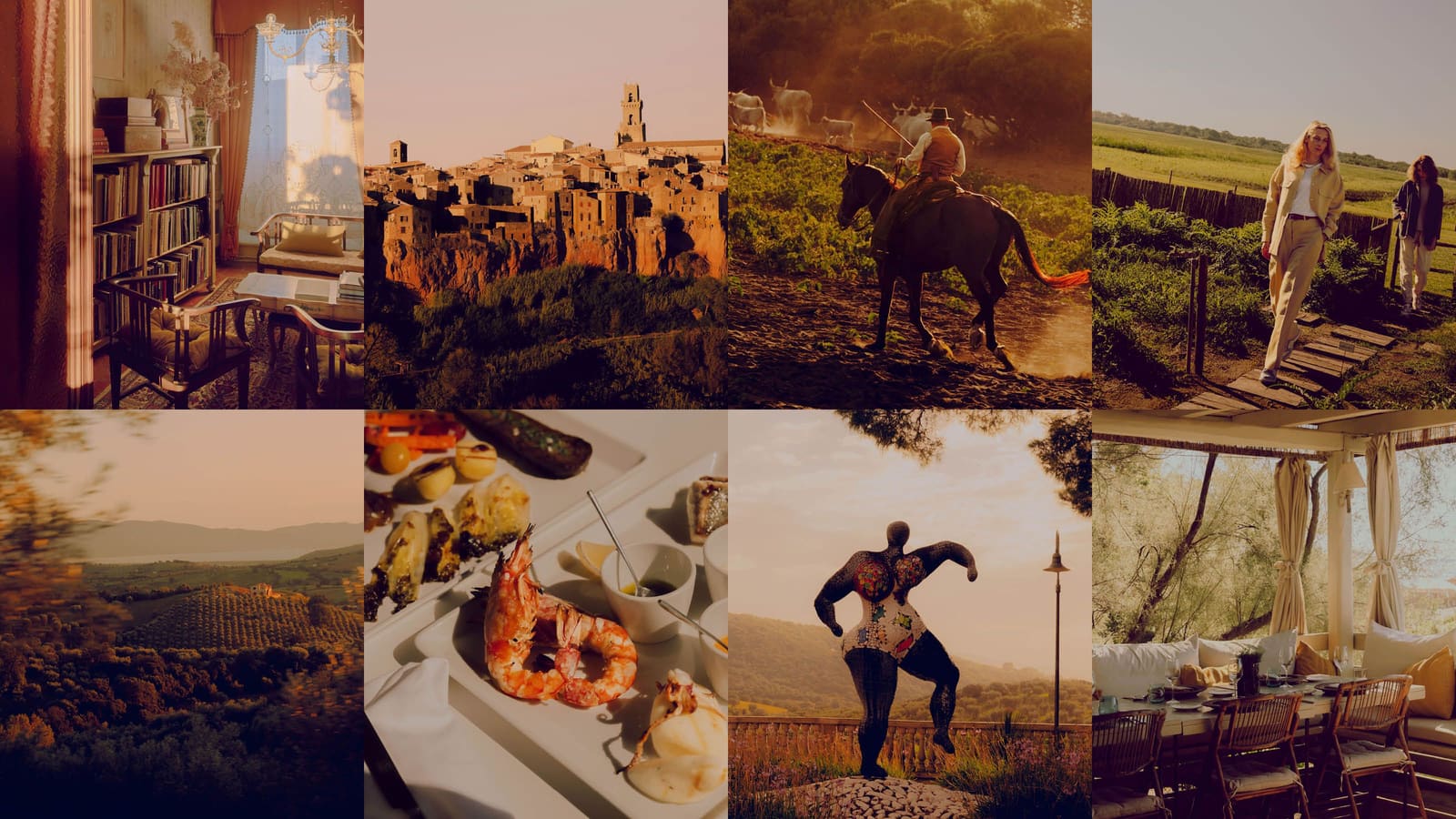
A Landscape That Time Forgot
The train south from Rome cuts through a stretch of Tuscany that most visitors never see. Wide plains roll toward the Tyrrhenian Sea, dotted with umbrella pines and grazing cattle. Ruined farmsteads sit silent on low hills. The shoreline south of Livorno feels emptied out, especially to anyone fresh from the crush of Florence or Pisa.
This is the Maremma, a region that carried a grim reputation for centuries. Marshes bred malaria. Dante compared a forest here to the seventh circle of hell. Watchtowers along the coast stood guard against pirates and bandits. Mussolini ordered the marshes drained in the 1920s and 1930s, and by the 1950s the land had been reclaimed for agriculture.
The wildness that remains is deliberate. Where other parts of Tuscany have leaned into tourism, the southern Maremma has held back, shaped by a mix of conservation efforts, private estates, and a slower pace set by seasonal rhythms.
The Families Who Stayed
In the early 1960s, a handful of Roman families began buying land here. Journalist Nicola Caracciolo and his brother Carlo, who co-founded La Repubblica newspaper, were early arrivals. They brought friends: intellectuals, environmentalists, artists. Among them was sculptor Niki de Saint Phalle, who built a garden of giant psychedelic tarot sculptures on the Caracciolo property. Her bedroom sat inside the mirrored breast of a 50-foot sphinx; her kitchen occupied the other breast.
The Giardino dei Tarocchi opened to the public in the early 1990s and has since become a draw for the region, fueling a small art scene. Galleries and studios have opened nearby, and the Hypermaremma summer festival now brings installations to the Terre di Sacra estate, a sprawling property that stretches across 2,500 acres and seven and a half miles of coastline.
Terre di Sacra itself was born from a railway delay. In 1922, nobleman Uberto Resta Pallavicino found himself stranded after a signal failure. He spent the layover walking the coast and decided to gather a group of friends to buy up land. The estate became a private retreat for insiders from Rome and Milan, known mainly by word of mouth.
A Working Estate Under Pressure
Today the estate faces competing demands. The peat-rich soil attracts interest for mineral extraction. Water rights are contested. Development pressures are constant. To survive, the property has turned to hospitality and organic farming.
A tented camp sits in the dunes. In 2025, the estate added 24 wooden cabins designed in collaboration with Michaelis Boyd, the architecture firm behind Soho Farmhouse. The cabins come with memory foam beds, full kitchens, a communal pool, and a restaurant. All 29 villas and cottages on the property are now available for rent, a shift from the earlier practice of lending them quietly to friends.
Margherita Puri Negri, whose parents own the estate, oversees the expansion. She describes the challenge as protecting not just wildlife and landscape but an entire way of life. The butteri, Tuscan cowboys who have herded cattle on horseback since Etruscan times, still work the land. The rare long-horned Maremmana cattle they tend nearly disappeared when Italian agriculture mechanized, but the slow food movement has revived interest in their lean, mineral-rich meat.
Where the Birds Outnumber the People
Lake Burano sits at the heart of the estate, a brackish body of water ringed by dunes and bullrushes. Around 300 bird species pass through or breed here, including flamingos, marsh harriers, and herons. The lake is part of a nature reserve that dates to 1967, when the World Wildlife Fund established a presence on Terre di Sacra land. At the time, refusing hunting profits was an unusual choice for a private estate.
A 16th-century tower overlooks the lake from the far shore. From the top, the irrigation canals and cultivated fields form a grid across the lowlands. The estate grows organic produce for its rental properties. Beyond the farmland, the dunes stretch toward the sea, pinned in place by juniper and myrtle.
The coastline here is a mix of public and private. Wild stretches of beach alternate with clubs. La Dogana Beach Club, part of the Terre di Sacra holdings, offers neutral tones, oversized loungers, and a scene of tanned Italians playing padel. Further down the sand, Ultima Spiaggia draws a livelier crowd, with music and football games. La Macchia, the estate's members-only beach club, sits at the far end, accessible only by invitation.
The Promontory and the Port
Monte Argentario juts into the sea south of the Maremma plains, connected to the mainland by two narrow sandbars. Porto Ercole, tucked into the promontory, has long been a quiet retreat for Romans. The town resists tourist trappings; menus stay in Italian, and souvenir shops are scarce.
La Roqqa Hotel opened recently on the bay, wedged beside a Spanish fort. The design nods to 1960s and 1970s modernism. Guests have access to Isolotto, a beach club carved into the rocky coast. The club is open to non-guests for a fee, though space is limited.
The stretch of pine forest known as La Feniglia runs along the northern sandbar. Caravaggio is thought to have died of malaria on these dunes in 1610, a reminder that the Maremma's transformation is recent.
A Question of Balance
The Maremma's appeal lies in what it has avoided. Crowds are thin. Development is patchy. The landscape still feels raw in places. But that balance is fragile. Water, land, and access are all contested. The families and estates that have shaped the region so far are now weighing how much to open up and how much to hold back.
For travelers, the draw is straightforward: space, quiet, and a version of Tuscany that does not require elbowing through tour groups. The train from Rome still runs along the coast, and the fare remains under ten euros. The view out the window has changed slowly, if at all.