More Than Just Bones
Paris built its famous underground ossuaries when cemeteries ran out of space in the 1700s, moving millions of remains into former quarry tunnels. The city turned a public health crisis into a monument. But Paris wasn't alone. Across Europe, Latin America, and even North America, communities carved out subterranean resting places that tell quieter, stranger stories about how people honor their dead.
Some were practical fixes. Others became pilgrimage sites. A few turned into folk shrines where locals made wishes to anonymous skulls. Today, many of these crypts are open to visitors willing to descend a steep staircase and spend an hour in the cool dark.
Naples and the Cult of Forgotten Souls
Naples has an unusual relationship with its buried. In the 1600s, plague and cholera killed tens of thousands, and bodies piled up faster than the city could process them. Caves on the edge of town became overflow graveyards. By the late 1800s, a priest named Gaetano Barbati had started organizing the remains, stacking skulls and long bones on shelves in the Fontanelle Cemetery complex.
What happened next was distinctly Neapolitan. Women from the neighborhood began adopting skulls, naming them, leaving offerings, and slipping handwritten prayers into empty eye sockets. The practice grew into what scholars call the "skull cult," rooted in Catholic ideas about purgatory. If no one prayed for the dead, the thinking went, their souls languished. So locals took it upon themselves.
The cardinal shut down Fontanelle in 1969, calling the devotion unhealthy. It reopened decades later, now requiring advance reservations. Not far away, the Church of Santa Maria delle Anime del Purgatorio ad Arco houses another set of crypts from 1638, where a lay group buried Naples's poorest residents. One skull, nicknamed "Princess Lucia," still draws women seeking help with marriage. Visitors leave her veils and tiaras.
Elsewhere in the city, the Catacombs of Saint Gaudiosus hold some of the oldest Christian art in Europe. A Tunisian bishop, exiled by Vandal kings in the 430s, washed ashore near Naples and founded a monastery. Centuries later, Dominican monks revived the site with a macabre twist: they drained bodies over the course of a year, plastered them, and painted frescoes of skeletons around the preserved heads. One artist, Giovanni Balducci, asked to be buried there instead of accepting payment. The site stayed hidden under a busy neighborhood until archaeologists began excavations in 2006.
New York's Candlelit Crypts
Old St. Patrick's Cathedral in Manhattan has crypts that rank among the few true burial vaults in the United States. Built to serve waves of Irish, Italian, Hispanic, and Asian immigrants, the church once stood as a flashpoint in anti-Catholic violence. Bishop John Hughes, known for his sharp temper, organized armed parishioners to defend it from a mob.
Below the sanctuary, tombs hold Congressman John Kelly, who advised Abraham Lincoln, and members of the Delmonico family, whose restaurant is the oldest in New York still operating. General Thomas Eckert, a Civil War veteran, rests in a vault fitted with original Thomas Edison light fixtures and tilework by Rafael Guastavino, the engineer behind Ellis Island's iconic interiors.
For two centuries, only clergy and family members could enter. Now the cathedral runs candlelit tours open to the public.
Malta's Rock-Hewn Tables
Malta's burial tradition stretches back to Roman times, when law required graves outside city walls. The catacombs at Rabat, split between the better-known St. Paul's and St. Agatha's sites, hold more than 1,000 bodies across 2,200 square meters. Families carved private chambers, but they also built communal halls with stone couches and circular tables where relatives gathered annually to commemorate the dead.
One smaller site, St. Cataldus, gets less attention but preserves one of the finest examples of an agape table, a rock platform used in early Christian funerary meals. Steep stairs lead down to canopied tombs from the 2nd and 3rd centuries, marked with dove carvings.
Another complex, Ta' Bistra, was rediscovered in 1891 beneath a farmhouse in Mosta. It dates to the 4th century and runs 300 feet through 16 chambers. Over the years, the tombs were used to pen animals, and during World War II, locals sheltered there during air raids. The farmhouse is now a visitor center with wheelchair access.
Mexico's Neo-Gothic Labyrinth
In León, Templo Expiatorio rises in white stone with a rosette window that echoes Notre-Dame. Below, seven crypts connect into a single network holding 1,919 remains. Construction started in 1924 but was interrupted twice: first by a flood, then by the Cristero War, a religious conflict that halted building for years. Work resumed in 1930. Locals joked that the temple's completion would signal the end of the world. It was finally finished in 2012. No apocalypse followed.
The crypts were designed to support the church's foundation, but they also function as a memorial, with narrow corridors and cramped chambers that require guides and good lighting.
Fake Catacombs in Washington
Beneath the Franciscan Monastery of the Holy Land in America, a maze of wall graves looks ancient but isn't. Franciscan monks built it at the turn of the 20th century to give North Americans a taste of the Holy Land without the cost or difficulty of overseas travel. Roman architect Aristides Leonori designed the space using photographs and measurements from actual Roman catacombs, casting the walls in cement rather than carving them from rock.
Most of it is replica. One exception: a skeleton believed to belong to a second-century child martyr, brought from Rome in 1929 with papal approval. The space is divided into three sections, each representing a different chapter of early Christian history.
Serbia's Military Tunnels
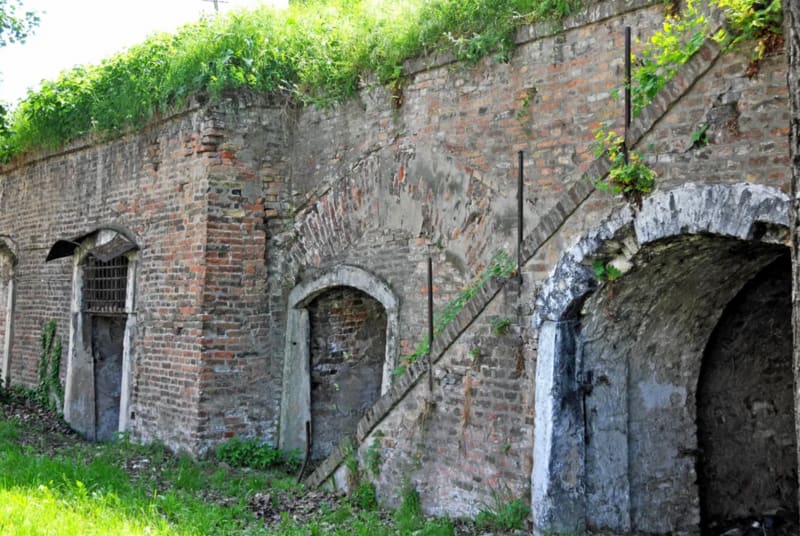
Petrovaradin Fortress sits on the Danube where the old town meets Novi Sad, Serbia's second-largest city. Built starting in 1692, it earned the nickname "Gibraltar of the Danube" for its strategic importance. Few visitors know about the four-story network of military galleries running beneath it, stretching roughly 10 miles in total.
Each level is marked by a different color. The fourth, coded black, is the most mysterious. It contains the so-called Kaiser Well, from which Habsburg rulers allegedly drank. Walls bear Maltese crosses, Masonic symbols, and alchemical inscriptions. Local legend says part of the Austrian Imperial Treasury was hidden here to keep it from Napoleon, and that some of it remains lost.
England's Sealed Amphitheater
Birmingham's Jewellery Quarter is known for engagement rings, but Warstone Lane Cemetery honors the past. Opened in 1848, it took burials until 1982, with tiered semicircular catacombs that resemble a Roman amphitheater. Most of those interred were poor, victims of 19th-century industrial overcrowding. One exception: John Baskerville, the English typographer, whose remains were moved here in 1897 after his original crypt was demolished. The catacombs are now sealed, no longer open to tours.
Portugal's Golden Church and Bone Piles
Igreja de São Francisco in Porto is Gothic outside, Rococo inside. Four hundred kilograms of gold coat the wood carvings and statues. Below three interior chapels, crypts hold members of the Franciscan order. A grated glass window in the floor lets visitors look down at heaps of human bones. When Napoleon's forces took Porto, legend says he turned the church into a stable.