A Quiet Arrival
The June sun hung low at nine in the evening when the plane touched down in Boise. The airport felt almost deserted, clean and orderly in a way that suggested either careful planning or not enough traffic. Outside, the city stretched across the valley in a way that seemed inefficient at first. Closed restaurants marked the major intersections. Then the Boise River appeared, and with it the downtown core: historic buildings, office towers, and the Idaho State Capitol glowing at the end of a main street.
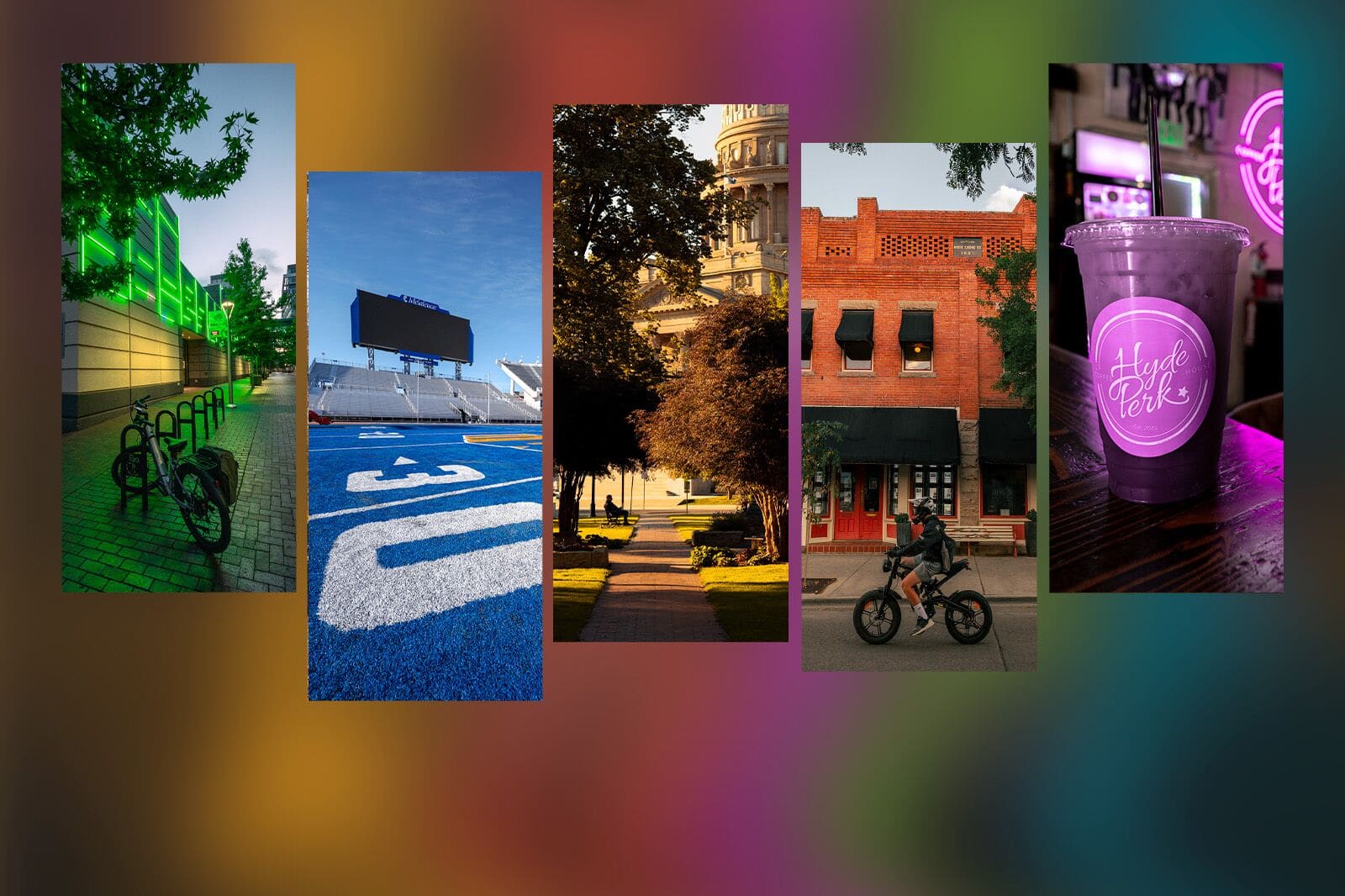
The plan was simple. Two days to photograph the city through a chosen palette: blue for Boise State, green along the river, gold in the foothills, copper in the architecture, and purple wherever it might turn up. Color became a way to organize a place that was otherwise unfamiliar.
Blue, Interrupted
Blue is Boise's calling card. Boise State University's football field has been blue since 1986, a turf color that became shorthand for the city itself. The shade matched the promise of 200-plus sunny days and the outdoor culture built around the river.
But when the stadium came into view, heavy machinery sat on torn-up sections of the field. A renovation crew had ripped out parts of the turf for replacement. The wide shots were gone. Instead, the work became about tight angles and close-ups, finding blue where it remained.
Later, at Boise Whitewater Park, blue appeared more naturally in the water and sky. But by then, another color had started to dominate the frame.
The Green City
Green was the first surprise. Boise is named after the French word for wooded, and the nickname holds. The Boise River Greenbelt runs for 25 miles through the city, connecting parks and neighborhoods. The Idaho Botanical Garden sits on 15 acres near the Old Idaho Penitentiary. Hyde Park, a historic neighborhood north of downtown, is dense with trees.
Idaho had registered in advance as dry and agricultural, a state of potatoes and high desert. Boise turned out to be a city of parks where people walk and run before sunrise, where trees offer shade on nearly every block, and where flocks of geese can hold up traffic without provoking honking.
The green infrastructure is not decorative. It shapes how people move through the city and how the city stays cool in summer. It also meant that half the photos taken over two days ended up featuring green, whether that was the goal or not.
Gold in the Long Light
Gold in Boise belongs less to objects than to time of day and the surrounding landscape. The foothills rise immediately east of the city, covered in dry grass that glows in early and late light. Summer days stretch long this far north, and the golden hour extends well past what photographers expect in other climates.
Camel's Back Park, just north of downtown, offered the best vantage point. At sunrise, the grass began to glow before the sun cleared the mountains. The contrast with the dark blue sky and the green of the park below created the kind of layered scene that does not require much intervention to photograph well.
That stretch of warm light felt like the real luxury of shooting in Boise in June. The conditions were forgiving. There was time to experiment, to move locations, to wait for better compositions without losing the light entirely.
Copper and Permanence
Where gold shifted with the sun, copper stayed constant. It showed up in the iron bridges over the Boise River, in the Capitol dome lit from within, in the red brick and sandstone facades downtown, and along the Basque Block, where Boise's Basque community has maintained restaurants and cultural spaces for decades.
The Idaho State Capitol looked forbidding from the street, formal and closed off. But the accessible entrance led to the Garden Level Rotunda, and from there the dome opened above in an unexpected vertical view. The interior copper tones, combined with the geometry of the dome, made for one of the strongest images of the trip.
Copper became associated with the older layers of the city, the parts that predate the outdoor recreation economy and the tech sector growth. It is the color of a city that was built with brick and stone, not glass and steel.
Purple, by Request
Purple is hard to find in cities. In Boise, it appeared in flowering shrubs at the botanical garden, in sidewalk planters downtown, in the wine culture of nearby Garden City, and in street art.
The search for purple also brought out the hospitality that ended up defining the trip. At Hyde Perk, a coffee shop in Hyde Park, the baristas asked about the photo project. When they learned purple was on the list, they offered to make a drink in that color, on the house. They warned against drinking it. The goal was the color, not the taste.
That kind of gesture happened more than once. A staff member at City Peanut Shop recommended a sunset spot. The crew at Bar Gernika handed over a can of locally made kombucha just so there would be something local to photograph. Strangers stopped to ask about the camera and the project, then offered suggestions.
Boise is not a large city. The population sits around 240,000. But it felt unusually open to visitors, willing to share what makes the place work for the people who live there.
Beyond the Palette
Freak Alley, an open-air street art gallery downtown, brought all five colors together in one location. The murals cover walls, doors, and alleyways, and the palette extends well beyond the five colors chosen for the project.
By the second day, the color framework started to feel limiting. Boise's real character was not in the palette but in the way the city moved: the runners on the Greenbelt before dawn, the families at Julia Davis Park in the afternoon, the quiet streets of the North End, the Basque restaurants serving chorizo and cider.
The colors were a useful entry point. They provided structure and a reason to cover ground quickly. But the city revealed itself more in the moments between shots than in the images themselves.
On the way back to the airport, the camera held hundreds of photos organized by hue. What stayed more clearly was the sense of having been welcomed into a place that did not need to prove itself, that knew what it was and did not mind if visitors took a while to figure it out.
Boise is not a city that announces itself loudly. It takes a slower approach, offering parks and light and the occasional purple drink made by baristas who want to help. Two days is enough to see the outlines. It is not enough to understand how it all fits together. That would take more time and no palette to follow.