The Problem With Christmas Markets
Visit one European Christmas market and you've essentially visited them all. The wooden stalls look identical. The warm spiced wine tastes the same whether you're in Prague or Munich. That's not a complaint, just an observation about what makes for interesting travel planning. If you're choosing where to spend December based on which city has the most atmospheric booths, you're optimizing for atmosphere that exists everywhere.
What doesn't exist everywhere: centuries-old rituals involving horned figures chasing people with sticks, or contests to see who can carve the best nativity scene out of root vegetables before they rot. These happen once a year, often on a single night, and missing the date means you've flown somewhere for nothing.
Demon Chases in the Alps
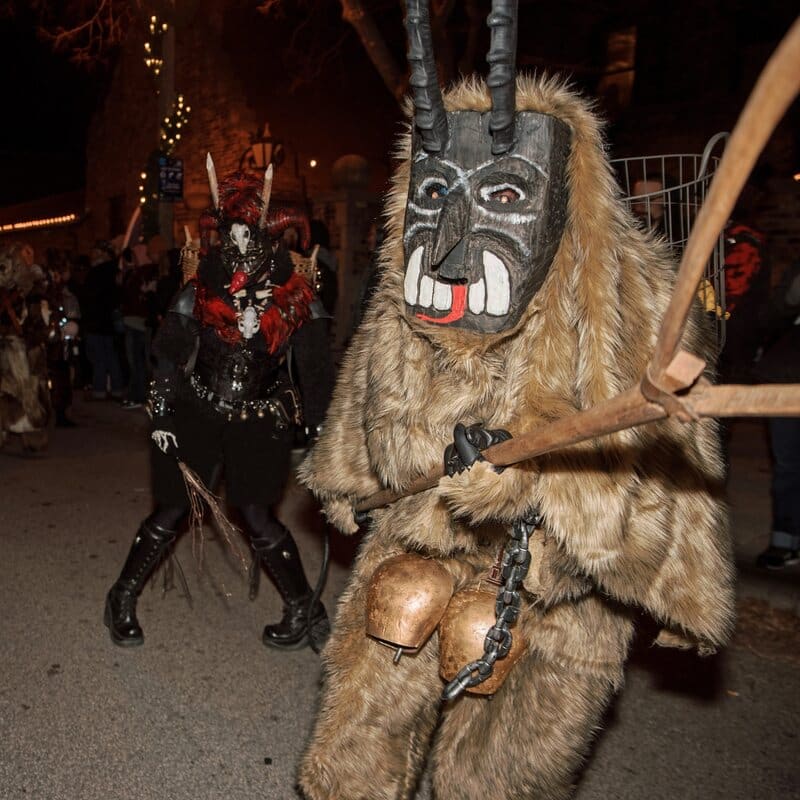
In parts of Austria and southern Germany, the days around December 5th and 6th bring Krampus runs. The creature itself has roots in Alpine folklore, but its current form took shape during the Counter-Reformation, when Jesuit theatrical productions in Bavaria and Tyrol started pairing Saint Nicholas with a devil figure as a warning to badly behaved children. The tradition stuck.
Today, costumed participants parade through town centers swatting spectators with birch branches. This is not a tourist show. It's rowdy, occasionally frightening, and happens whether visitors show up or not.
Milwaukee hosts a version every year near the old Pabst Brewery, complete with drum corps and over a hundred horned figures marching down the street. The city's German heritage runs deep enough that the event feels genuine rather than imported.
Less widely known is Frau Perchta, a winter witch who appears across Central Europe in white robes or as a hunched figure followed by the ghosts of unbaptized children. Some scholars argue she predates Christianity entirely, a goddess who survived by being recast as a monster.
Iceland's Livestock Problem
Iceland's Christmas folklore centers on a cat. The Yule Cat roams the countryside on Christmas Eve looking for anyone not wearing at least one new piece of clothing. Those who fail the wardrobe check get eaten.
The rule sounds random until you consider the incentive structure: children had to earn new winter garments through good behavior before the cold set in. The cat was enforcement.
It belongs to Grýla, a witch-giantess whose thirteen sons arrive one per night in the two weeks before Christmas. Their names include Sheep Worrier, Spoon Licker, and Window Peeper. The headmaster of Iceland's Elf School insists they were genuinely terrifying before modern retellings softened them. He also maintains they're real.
Their supposed home is Dimmuborgir, a field of black lava formations near Lake Mývatn in the north. The rocks formed during an eruption roughly 2,300 years ago and have long been associated with underworld mythology. One story claims Satan landed there after being expelled from heaven. The site includes a natural arch called The Church.
Visit between December 12th and Christmas Eve if you want to catch the Yule Lads in their element.
Sweden's Arson Tradition
Since 1966, the town of Gävle has built a forty-foot straw goat in its main square each December. An advertising consultant came up with the idea. His brother, the town fire chief, helped engineer the first one.
It burned down at midnight on New Year's Eve that same year. Since then, the goat has been destroyed dozens of times through arson, vehicular assault, and one attempted helicopter theft. The town has installed a webcam. The goat has social media accounts. Special street signs mark its location year-round.
The goat goes up the first Sunday of Advent and theoretically stays through New Year's, security permitting. Whether it survives any given season has become a matter of civic pride and international speculation.
Catalonia's Nativity Addition
Walk through Barcelona during the holiday season and you'll find nativity scenes with an extra figure tucked into the background: El Caganer, a small peasant in a red cap, squatting and defecating. He's been part of Catalan nativity displays since at least the 1700s.
Explanations vary. Some say he's fertilizing the earth for the coming year. Others frame him as a reminder that bodily functions coexist with the sacred. He might just be comic relief. Modern versions depict politicians and athletes. Finding him among the shepherds and wise men is part of the tradition.
Oaxaca's Vegetable Competition
On December 23rd, Oaxaca's main square fills with sculptures carved entirely from radishes. The subjects range from saints and musicians to replicas of the Pietà and miniature cemeteries. Some radishes weigh nearly seven pounds and measure eighteen inches long. The city grows them specifically for the competition to keep conditions fair.
Farmers started carving radishes to attract attention at the Christmas market. The formal contest dates to 1897. Go in the morning to watch the carving process and stay for the evening reveal. The sculptures exist for hours before wilting. Showing up a day late means seeing nothing.
Christmas Without a Calendar
Not everyone can book a December flight to Austria or Sweden. The United States has responded by making Christmas a condition that exists outside time.
Outside Colorado Springs, a Christmas-themed amusement park called the North Pole opened in 1956 and still operates under the same family ownership. It's open all summer. In New York's Adirondacks, Santa's Workshop features a talking tree and a working post office for letters to Santa.
Leavenworth, Washington, a town that decided to become Bavarian at some point in the 20th century, houses a Nutcracker Museum with over 7,000 specimens from fifty-plus countries. Traditional hand-carved soldiers, yes, but also Garfield, an Egyptian mummy, and a cast-iron Jimmy Carter prototype. The museum's mascot is a six-foot beer-drinking figure named Karl.
Seattle's Nutcracker House preserves remnants of a defunct local production and opens only from late November through December. Meanwhile, Santa's Village in California, a 1950s park designed partly by former Disney artists, sits in uncertain condition, a reminder that permanent Christmas eventually ends.
An Alaskan trading post became a Santa house after a child asked whether Santa was building a new home. The Arctic Circle post office has received an estimated seventeen million letters to Santa over the years.
What Actually Matters
Christmas markets are pleasant. The wine is warm, the huts are charming, and no one should feel guilty about visiting one. But they run for six weeks. A Krampus parade lasts a single night. A radish sculpture competition exists for hours.
If you're planning travel around the season, choose the city for what else it offers and then check the calendar for traditions that happen once. The market will be there whenever you arrive. The demon chase won't.