The Wait
Tarragona spent August 12, 2026, baking. The Mediterranean port city, layered with Roman ruins and two millennia of stories, turned into a gathering point for thousands who came to watch the sky go dark. Europe had not seen a total solar eclipse since 1999, and this one would pass directly overhead.
People arrived from everywhere. Some flew in from other continents, others took packed trains from Barcelona, shoulder to shoulder in cars without enough air. On the waterfront, families claimed patches of shade wherever they could find them. They played cards, stretched out in the sun, passed around watermelon during the Sindriada, a local tradition tied to the feast of Sant Magí and designed for exactly this kind of heat.
Hours crawled by. Diana, an architecture student visiting from Romania with her family, sketched the old buildings around her, adding a small eclipse in the corner of her page. Drawing helped the time move, she said. Willa, who had traveled from Philadelphia, embroidered a fabric map of her summer trip, stitching the eclipse at its center. When the partial phase began, she started to dance.
Boris had come from Switzerland with a telescope. He saw the 1999 eclipse in France, but clouds blocked it. Twenty-six years later, he was back, determined to see it clearly. Elpidio took the train from Barcelona with a camera rig he had built himself, hoping to capture totality on film.
The Tradition
Tarragona did not pause its rhythms for the eclipse. Castellers, practitioners of the Catalan tradition of building human towers, assembled in the streets. Children splashed in fountains. The nearly two-thousand-year-old Roman amphitheater sat above the water, a reminder that people have gathered here to witness spectacle for a very long time.
The city's Sant Magí festivities were already underway, and the Sindriada, a ritual of eating watermelon to cope with August's punishing heat, folded neatly into the day's larger event. Eva, visiting from Strasbourg, stood in line for a slice as the temperature climbed. The eclipse and the feast day overlapped, turning the wait into something communal rather than solitary.
The Moment
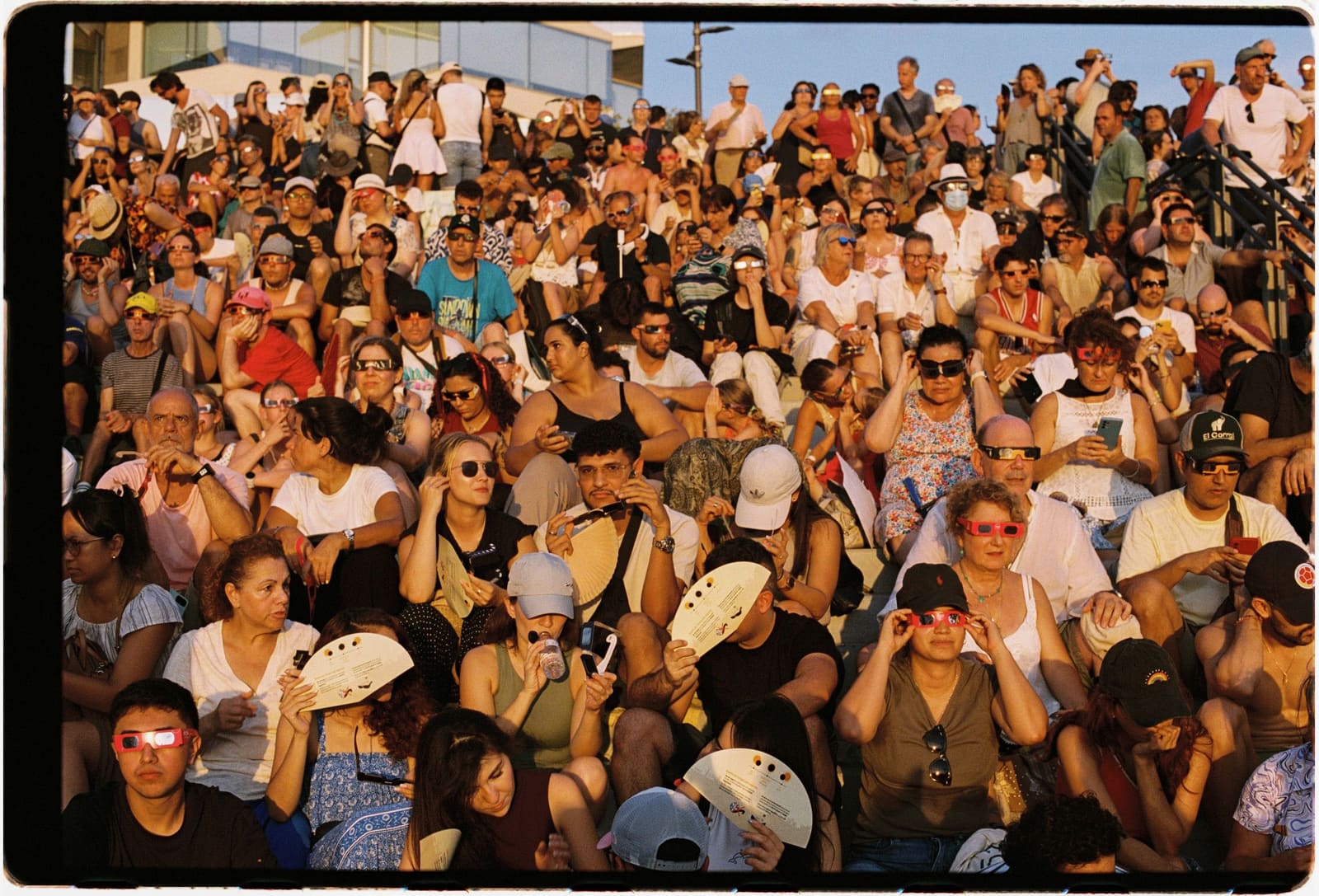
When the partial phase began, the crowd raised eclipse glasses in unison. The reflection of the crescent sun sent glittering patterns across the harbor. Families gathered on the pier, young and old, watching the moon inch across the sun's face.
Then totality arrived. The sky went dark. The crowd erupted. Some cheered, others cried. A flock of birds flew low over the water, confused by the sudden night. For just over a minute, the noise gave way to stillness. The world held its breath.
And then it was over. The sun returned, the heat resumed, and the long hours of waiting made sense. No one seemed to mind that they had spent the day baking under the very star they had come to see disappear.
Why People Go
Eclipse chasing is not a new pursuit, but the 2026 event reminded observers why it endures. A total solar eclipse offers something rare in travel: a phenomenon that cannot be manufactured, cannot be moved, and cannot wait. You go where it goes, or you miss it.
Tarragona was well suited to the task. The city has hosted visitors for centuries, first as the Roman provincial capital of Hispania Tarraconensis, now as a quieter alternative to Barcelona's crowds. Its waterfront provided open sightlines and space for thousands to gather without feeling crushed.
The eclipse also arrived during a moment when celestial events have regained popular attention. Advances in photography and social media have made it easier to share the experience in real time, drawing wider audiences to events that once felt niche. But the core appeal remains unchanged: standing in the moon's shadow is simply unlike anything else.
What Comes Next
The next total solar eclipse visible from Europe will not occur until 2027, when a narrow path will cross southern Spain and North Africa. The 2026 event over northern Spain drew significant crowds, and tourism officials are already anticipating similar interest for future eclipses.
For Tarragona, the day offered a reminder of what the city does well. It absorbed thousands of visitors without losing its character, blending ancient history with a modern event. The Roman amphitheater stood watch over the harbor as it has for two thousand years, indifferent to whether the sky above it was light or dark.
Eclipse chasers will move on to the next path of totality. But for one August afternoon, the moon's shadow passed over an old city on the Mediterranean, and thousands of people looked up together.