The Landscape Opens Up
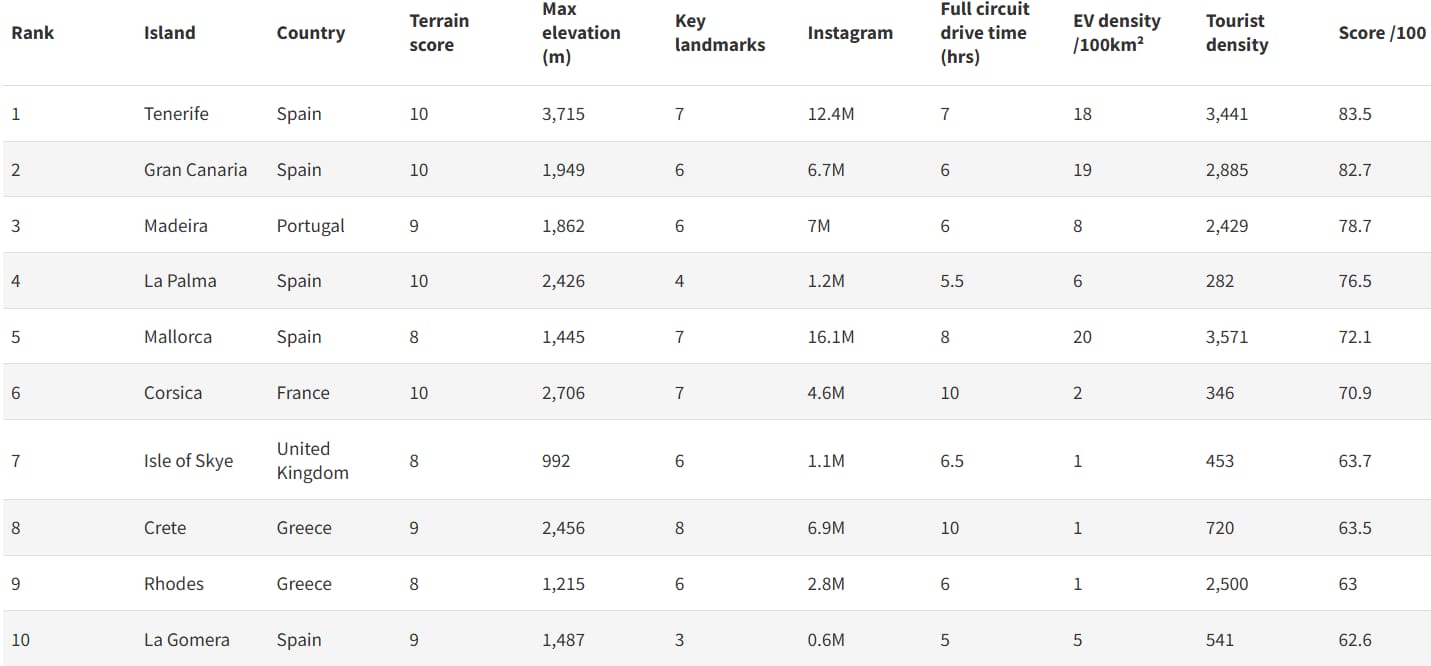
Most people arrive on European islands thinking of sand and sea, but the roads climbing inland tell another story. Tenerife's route through Mount Teide National Park rises 3,715 meters, Spain's highest point, where lava fields give way to green slopes and Atlantic views. Gran Canaria's interior roads move from beach resorts to desert-like dunes and rocky peaks, including the climb toward Roque Nublo. Madeira's cliffside routes hang above the ocean, connecting valleys and forests across a circuit that takes roughly six hours to complete.
These islands earn their scenic reputation not from a single viewpoint but from how quickly the terrain shifts. A drive on La Palma reaches 2,426 meters at Roque de los Muchachos, passing through Caldera de Taburiente National Park and volcanic formations. Corsica combines alpine environments at Monte Cinto, which stands at 2,706 meters, with Mediterranean coastlines and forested valleys. The Isle of Skye, off Scotland's northwest coast, strings together mountains, sea cliffs, waterfalls, and geological formations like the Quiraing and Fairy Pools along routes that feel ancient.
According to Avis, which analyzed European islands for road travel based on terrain, elevation, landmarks, tourist density, and driving conditions, the best island drives balance dramatic scenery with practical access. Some islands rank high for both views and seclusion, suggesting travellers don't always have to choose between spectacle and quiet.
The Case for Going Inland
Mallorca draws millions to its resorts, but the Serra de Tramuntana mountain range runs along the island's northwest, offering winding roads through valleys and over ridges that overlook the sea. Villages like Valldemossa and Deià sit along these routes, adding architecture and history to the landscape. Crete reaches 2,456 meters at Mount Ida, and its roads connect the Palace of Knossos and Samaria Gorge with mountain villages and beaches. Rhodes pairs its medieval Old Town, a UNESCO World Heritage Site, with interior forests and mountain roads that lead to archaeological sites and quieter communities.
La Gomera, another Canary Island, passes through Garajonay National Park, a UNESCO site protecting one of Europe's best laurel forests. The island's roads wind through ravines and mountains, revealing viewpoints and traditional villages. The sense of discovery comes from the island's smaller size and the fact that it receives far fewer visitors than Tenerife, its neighbour.
Where Seclusion Becomes the Feature
El Hierro, in the western Canaries, ranks as the most secluded island drive in Europe based on visitor numbers and remoteness. Volcanic landscapes, natural pools, and remote viewpoints define the experience, and its UNESCO Biosphere Reserve status underscores its environmental focus. Lesbos, in Greece, offers olive groves, mountain villages, and coastal areas without the crowds of Mykonos or Santorini. Travellers can visit Molyvos Castle, natural hot springs, and the Petrified Forest on routes that feel unhurried.
Samos, also in the eastern Aegean, combines mythology and forests with beaches and waterfalls. The ancient Heraion sanctuary sits on an island that maintains a slower pace. Gotland, Sweden's largest island, features Visby, a medieval town surrounded by a preserved wall, plus rocky Baltic coastlines and countryside roads. Korčula, in Croatia, crosses vineyards and forests before reaching Adriatic beaches and the medieval streets of Korčula Town.
The Faroe Islands, a Danish archipelago of 18 volcanic islands, connect via tunnels, bridges, and ferries. Steep cliffs, green mountains, and small villages create a setting that feels removed from typical tourist circuits. Weather shifts constantly, altering the scenery and adding unpredictability to the drive. Brač, another Croatian island, offers clear waters and traditional stone villages, including Zlatni Rat beach near Bol, alongside mountain and countryside routes that can be covered at a relaxed pace.
What the Rankings Reveal
The islands that appear on both scenic and secluded lists, La Gomera, La Palma, and Skye among them, suggest that impressive landscapes don't always come with crowds. Elevation plays a role: islands with significant height variation offer more dramatic views and diverse ecosystems within short distances. Cultural landmarks, from Crete's archaeological sites to Rhodes' medieval core, add depth to drives that might otherwise focus solely on nature.
Tourist density matters, but it's uneven. Mallorca's resorts are packed, yet its mountain roads feel remote. Tenerife attracts millions annually, but Mount Teide National Park retains a sense of scale and space. The quieter islands, El Hierro, Lesbos, the Faroes, draw travellers specifically looking to avoid the busiest destinations, and their infrastructure reflects that. Roads are narrower, villages smaller, and the rhythm slower.
The Rhythm of Island Driving
Island road trips work because the boundaries are clear. You can't drive indefinitely; the sea eventually stops you. That limitation forces routes to loop, double back, or connect coastal and inland areas in ways that feel complete. A full circuit of Madeira takes six hours, but the point isn't speed. It's the sequence of forests, cliffs, natural pools, and villages that build a sense of place.
La Gomera's routes lead to hidden viewpoints and remote corners where the only company is the landscape. Corsica's roads pass through forests and valleys, creating a feeling of exploration even on well-travelled routes. The Isle of Skye's scenery appears around every corner, a function of geology and weather that makes the island feel constantly in motion.
Why It Works
Europe's island drives succeed because they offer freedom within limits. The car provides access to places ferries and buses don't reach, but the island's size keeps the journey manageable. You can explore without losing your sense of direction. The best routes balance natural features, mountains, coastlines, forests, with human ones, villages, historic sites, traditional agriculture. They let travellers move at their own pace and stop where curiosity pulls them.
From Tenerife's volcanic heights to Gotland's medieval walls to the Faroes' tunnels and cliffs, the roads reveal what beaches alone cannot. They show how landscapes change with elevation, how villages fit into valleys, and how history and nature layer over one another. The islands that rank highest for both scenery and seclusion prove that travellers don't always have to choose. Sometimes the most dramatic views come with the fewest people, and the road that winds through them is enough.