A Spending Lead That Stands Out
Travelers from the United States drove the largest share of foreign card transactions in Belgium during the peak summer months, according to figures released by payment processor Worldline. Between late June and the final days of August, American visitors were responsible for just under a quarter of all international spending tracked through the system, outpacing every other nationality.
French visitors held second place in the rankings, with Dutch, British, and Luxembourg travelers rounding out the top five. German and Austrian visitors came next. The data reflects card payments only, offering a window into spending patterns rather than visitor volume.
Within Belgium, Americans topped the spending charts in both Brussels and Flanders. In the capital, their share climbed to more than two-fifths of all foreign transactions. Meanwhile, French visitors led spending totals in Wallonia, the country's southern region.
Volume Versus Value
The figures distinguish between total spending and the size of individual purchases. While Americans logged the highest cumulative outlays, they did not hold the record for average transaction size. That distinction belonged to Austrian visitors, who spent roughly 127 euros per purchase. Chinese travelers averaged 99 euros, and those from Luxembourg came in at 85 euros.
Brussels recorded the most foreign card payments overall, ahead of Antwerp, Bruges, and Ghent. Yet the highest per-transaction averages appeared along the coast, where international visitors spent an average of 61 euros each time they swiped or tapped.
Knokke-Heist, a resort town often compared to upscale Mediterranean destinations, posted the steepest average at 70 euros. De Haan followed at 67 euros, with Ostend at 65 euros. Close to half of all foreign purchases went toward retail, spanning everything from chocolate and keepsakes to jewelry, apparel, and books.
Coastal Resorts See a Strong Rebound
The spending data arrives alongside news that Belgium's North Sea coastline enjoyed its busiest summer since the pandemic began. During July and August, the region logged an estimated 11.2 million overnight stays, marking a rise of nearly one-tenth compared to the previous year.
The uptick fits into a broader pattern emerging across northern Europe, where travelers are choosing milder climates over traditional southern beach destinations that have faced repeated heatwaves and wildfire disruptions in recent summers. Belgium's coast, cooled by North Sea breezes, has benefited from this shift.
Jurgen Vanlerberghe, who oversees tourism for West Flanders and chairs regional agency Westtoer, described the season as triumphant. He noted that the summer atmosphere took hold in June and held steady through the school holidays.
July alone brought 5.6 million overnight stays, with August expected to match that figure. The coast also drew an estimated 6.1 million day visitors over the two months, the highest tally since 2019.
A Record Year for the Country
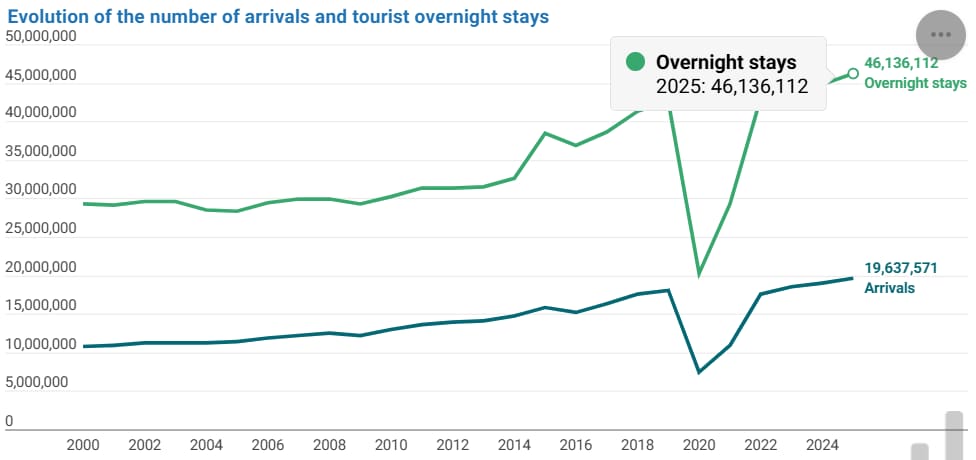
The strong coastal performance caps a banner year for Belgian tourism as a whole. In 2025, the country registered more than 46.1 million overnight stays, up nearly 3 percent from the year before. International demand grew even faster, with foreign overnight stays climbing 4 percent.
American travelers ranked as Belgium's fifth-largest source market by volume in 2025, generating over 1.1 million overnight stays. Visitors from the Netherlands, Germany, France, and the United Kingdom logged higher numbers. Yet the spending data underscores that Americans punch above their weight in economic impact, leaving behind a disproportionate share of tourism revenue relative to their headcount.
The gap between visitor numbers and spending highlights a recurring theme in European tourism: some markets bring volume, others bring value, and the most sought-after travelers often deliver both. For Belgium, the American market appears to deliver the latter in spades.