A Lopsided Map
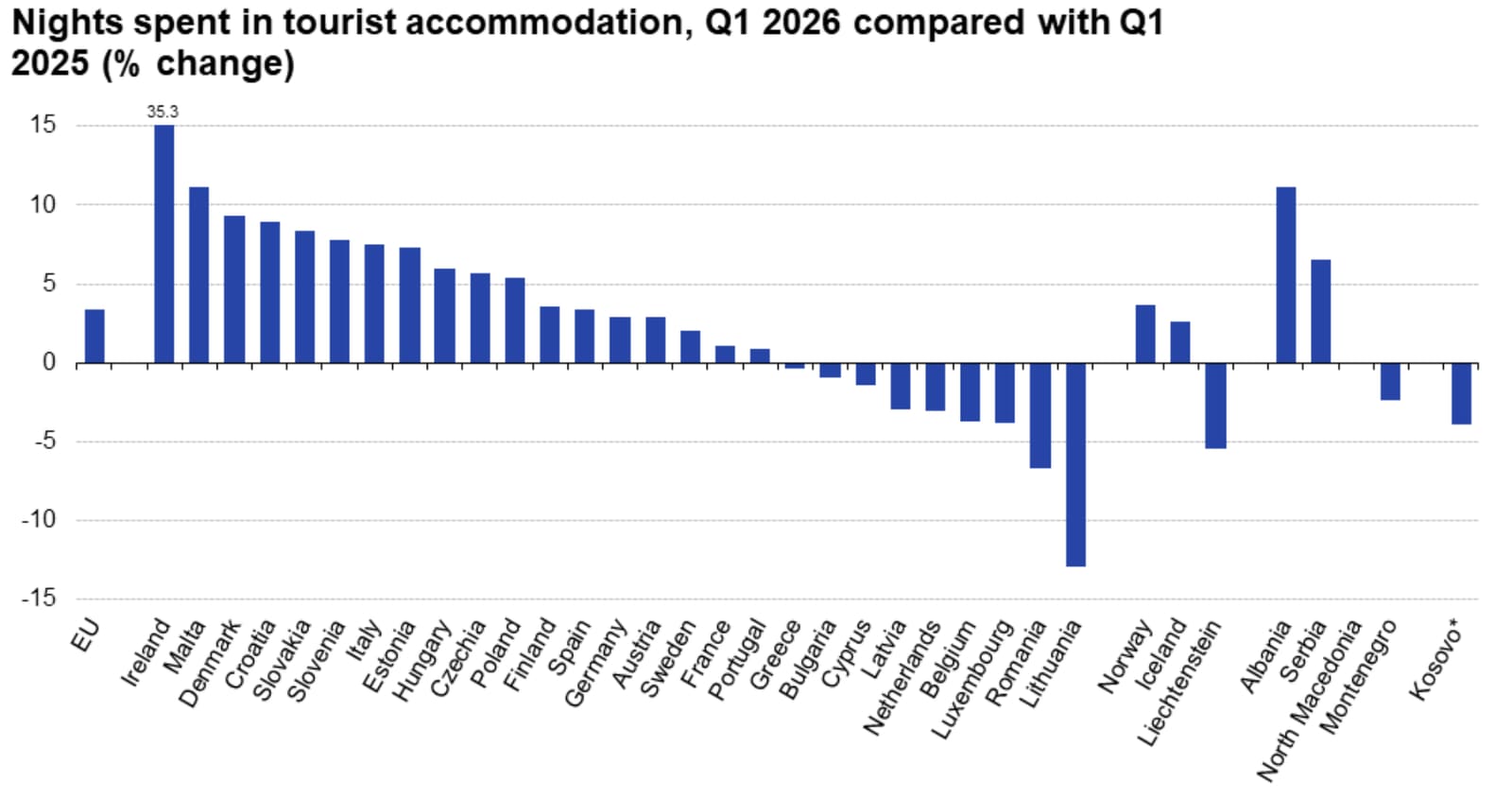
European tourism hit a milestone in 2025, crossing 3 billion overnight stays for the first time. Yet the activity is far from evenly spread. Seven regions absorb nearly one in five of those nights: the Canary Islands, Croatia's Adriatic coast, greater Paris, Catalonia, Andalusia, Veneto, and the Balearic Islands, according to the European Commission.
The pattern reflects both Europe's appeal and one of its sharpest challenges. Visitors flock to the same beaches, cities, and cultural landmarks, leaving other areas underutilized and some destinations stretched thin. Spain, France, Germany, and Italy together account for more than 60 percent of all EU tourist nights, underscoring how concentrated the flows really are.
Pressure Points
Tourism intensity varies dramatically when measured against local populations. Mediterranean and island destinations often see visitor numbers that dwarf their resident counts, creating pressure on housing, water, transport, and public services. For a city like Venice or a coastline like Croatia's Dalmatia, the weight of arrivals can become a year-round planning headache, even if most visitors arrive in a narrow window.
The Commission's data highlight what it calls "uneven tourism dependency." Some regions rely heavily on visitor spending, while others have scarcely developed their tourism sectors. That imbalance can distort local economies, inflate property prices, and strain infrastructure in popular areas, while leaving potential elsewhere untapped.
Summer Surge
Seasonality compounds the geographic squeeze. In 2024, 42 percent of all EU tourism nights fell in July and August. That means nearly half the year's activity compresses into eight weeks, amplifying crowding, driving up costs, and concentrating environmental impact.
The figures suggest that even modest shifts in timing could ease pressure. Encouraging travel in shoulder months, promoting winter destinations, or highlighting less-known regions could distribute visitors more sustainably without reducing overall numbers.
Growth and Its Discontents
Europe remains the world's most visited region. The EU recorded 582 million tourist arrivals in 2025, roughly 38 percent of the global total and above the 540 million arrivals logged in 2019. Yet Europe's share of worldwide tourism has slipped from 47 percent in 2022, as other regions recover and compete more effectively.
Tourism's economic weight makes managing it a delicate task. EU residents alone spent an estimated €618 billion on tourism trips in 2024, and the sector provides jobs and income across the continent. Tightening access or discouraging visitors risks damaging livelihoods in places where tourism is a primary industry.
A Strategy in the Works
The European Commission is preparing an EU Sustainable Tourism Strategy, expected in 2026, to address overcrowding, seasonality, climate impacts, labor shortages, and the need to ensure local communities benefit from visitor spending. The strategy is likely to encourage diversification, both geographic and temporal, as a way to preserve destinations and improve the visitor experience.
The question facing policymakers is no longer how to attract more tourists. Europe already has them. The challenge is how to spread them out, so that the Canary Islands or Dubrovnik don't bear the brunt while quieter regions sit idle, and so that August doesn't eclipse the rest of the year. For travelers, that could mean discovering places that haven't yet made it onto the standard itinerary, and for destinations, it could mean a more stable, sustainable flow of visitors throughout the calendar.