First Decline Since the Pandemic Rebound
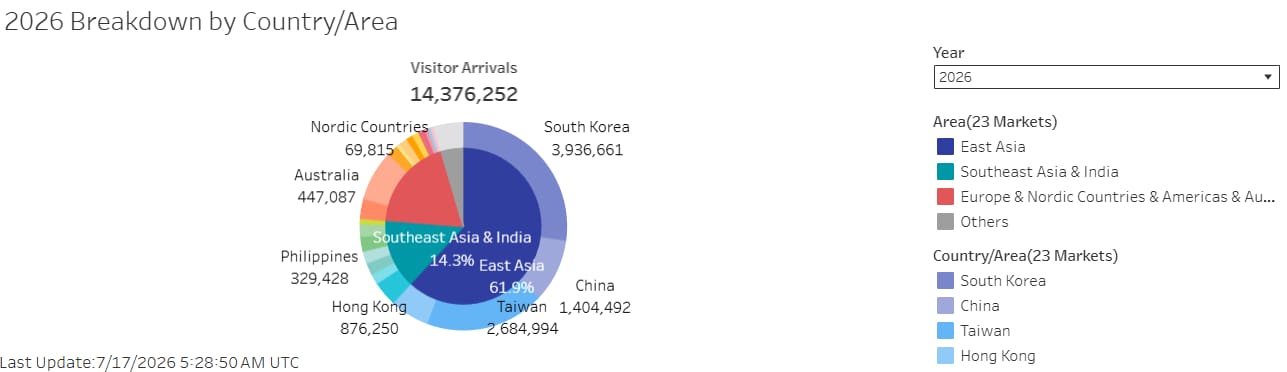
Japan recorded 21 million international arrivals in the first half of 2026, down 2% from the same period in 2025, according to the Japan National Tourism Organization. The drop marks the first time visitor numbers have fallen since the country reopened after COVID-19 restrictions.
Nearly the entire decline traces back to a single market. Chinese arrivals dropped 56% after Beijing issued a travel advisory in late 2025 warning citizens to avoid Japan due to rising tensions over Taiwan. Airlines responded by cutting flight capacity between the two countries, making travel both less accessible and more expensive.
China had long been among Japan's top three source markets. It now sits below South Korea and Taiwan, both of which posted double-digit growth.
Who Filled the Gap
South Korea sent 5.46 million visitors in the first half of 2026, an 18.6% increase that pushed it to the top of the rankings. Taiwan followed with nearly four million arrivals, up 21%. Vietnam and Malaysia also grew, and Southeast Asia as a whole accounted for 11.2% of all visitors, totaling 351,000 people.
The United States, Japan's highest-spending market per capita, increased arrivals by 2.7% to around 354,000. European markets had a strong showing. France, Italy, Spain, the United Kingdom, and the Nordic countries all hit record arrivals in June. India grew 26%, and the Middle East sent nearly 30% more visitors than the year before.
Thailand and the Philippines, however, declined as source markets, mirroring the broader contraction in parts of Asia.
Spending Held Steady Despite Fewer Arrivals
Even with half a million fewer visitors, total spending barely budged. International travelers spent approximately 2.51 trillion yen, or $14.49 billion, in the first half of 2026, a 0.2% increase over the prior year, according to the Japan National Tourism Organization.
The stability reflects a shift in the visitor mix. Markets that grew tend to spend more per trip. American and European travelers, for instance, typically stay longer and spend more on accommodation, dining, and retail than visitors from Northeast Asia. Indian and Middle Eastern tourists, both growing segments, also tend to book higher-end experiences.
The data suggests Japan's tourism economy is becoming less reliant on sheer volume and more on the composition of arrivals. That may be a fortunate alignment with the country's broader goals.
Navigating Overtourism While Chasing Growth
Japan welcomed a record 43 million visitors in 2025, a 16% jump from the year before. The surge brought economic benefits but also friction. Kyoto introduced measures to limit tourist access to certain geisha districts after complaints from residents. Mount Fuji hiking trails now charge entry fees. Several cities have raised accommodation taxes.
Despite those pressures, the government still aims to reach 60 million annual visitors by 2030. The strategy focuses on dispersing tourists beyond Tokyo and Kyoto, encouraging repeat visits, and nudging travelers toward higher spending rather than simply adding more arrivals.
The first half of 2026 offers early evidence that parts of that plan are working. Spending rose even as numbers fell, and newer markets are diversifying the visitor base. But the loss of Chinese tourists remains a significant gap, both economically and diplomatically.
The China Question
Chinese visitors historically spent less per person than Western or Middle Eastern tourists, but their volume made them indispensable. At their peak, they represented one of the largest inbound flows to Japan, supporting regional economies, retail sectors, and airlines.
Observers have noted that no single market can easily replace China's scale. While South Korea and Taiwan have stepped up, their combined populations are a fraction of China's, and both markets are already well-penetrated. Growth from Europe, North America, and India is promising but incremental.
The situation puts Japan in a delicate position. Tourism officials can point to resilient spending and diversification as signs of strength, but the underlying tension is harder to address. A travel advisory rooted in geopolitical friction is not something a tourism campaign can fix.
For now, Japan is leaning into the markets that are growing and hoping that the broader strategy of quality over quantity can absorb the shock. Whether that holds as the country pushes toward 60 million visitors remains to be seen.