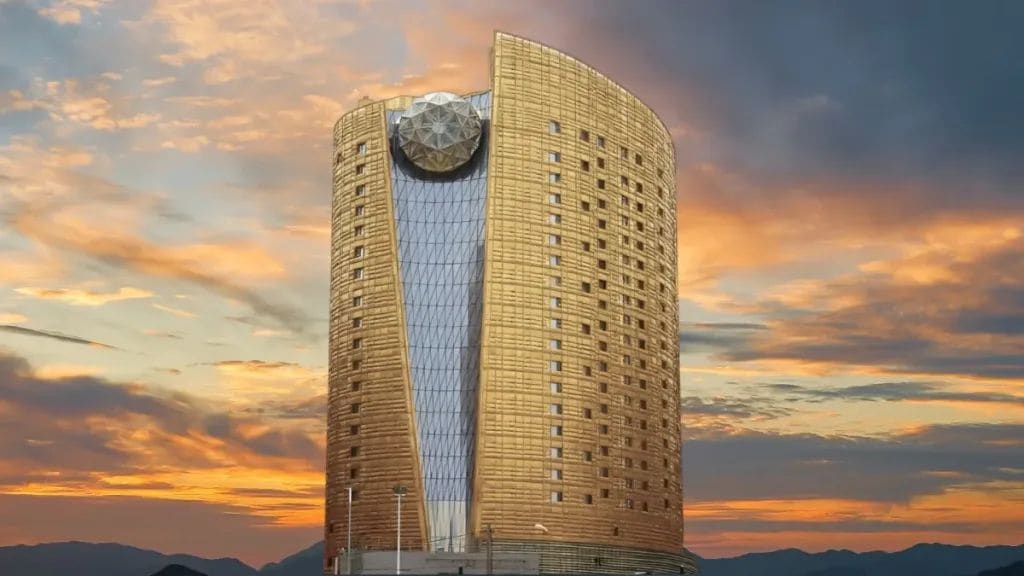
A Second Life in Gold
A hotel that once promised to redefine luxury is getting another chance. The property formerly known as Hotel 13 in Macao has reopened as 13 Palace, sporting a gold exterior instead of its original red and hoping to shake off a rocky past. Executive director Lui Ka Hei described the phased launch as an effort to move beyond earlier perceptions, starting with 50 to 100 rooms before scaling up.
The hotel, located in Coloane's Seac Pai Van district on reclaimed land south of Macao's main peninsula, was conceived by Hong Kong businessman Stephen Hung as a statement project. Construction delays and financing troubles plagued the venture before it finally opened in 2018, only to close two years later when the pandemic arrived. Bankruptcy followed in 2023. Last year, Rio Hotel chairperson Loi Keong Kuong acquired the property for HK$598 million, roughly US$72 million, and secured a renewed five-star deluxe license from the Macao Government Tourism Office.
The original vision was extravagant. Each of the 199 suites cost over US$7 million to build, according to Hung, who positioned the hotel as a new benchmark in ultra-luxury. The entry-level Villa du Comte featured Baroque flourishes, sculptures, and high-end fabrics. Guests had private elevators, Roman baths, colonnades, and personal butler service. A fleet of custom Rolls-Royce Phantoms, painted red to match the building, provided transport.
What Went Wrong
Opulence alone could not guarantee success. The hotel's location worked against it. Situated away from the Cotai Strip and Macao's main casino hubs, it struggled to draw the high-roller crowd that fuels much of the city's hospitality economy. The property never secured its own satellite casino license, a significant handicap in a market where gaming revenue and hotel occupancy are closely linked.
Critics also questioned the aesthetic. The red Baroque palace, with its maximalist interiors and gold-trimmed details, divided opinion. Some saw grandeur; others saw excess. Either way, the hotel failed to turn a profit before COVID-19 forced it to suspend operations in early 2020.
Repositioning for a Different Guest
The new ownership is aiming for a different audience. Rather than chasing casino players, 13 Palace is marketing itself to affluent leisure travelers from mainland China, Japan, South Korea, and Southeast Asia. The location, once a liability, is now being framed as an asset. The hotel sits near a golf course and the Giant Panda Pavilion, attractions that appeal to families and visitors looking beyond the gaming tables.
The property holds two Guinness World Records: one for the most hotel elevator lobbies and another for the tallest semi-indoor vertical garden, a green wall stretching from the fifth to the 20th floor. These features, along with the hotel's dining options, are part of the pitch. Restaurants offer Cantonese, Chiu Chow, Italian, and Japanese cuisine. The Chairman's Bar, with its Baroque blue glass design, anchors the hospitality spaces. Spa facilities, limousines, and 24-hour butler service remain standard across all suites.
The Test Ahead
Bookings are currently running at 50 to 60 percent, according to hotel sources, though online reservations do not yet appear widely available outside Macao. The phased opening is designed to build momentum and generate social media buzz, a strategy that relies on guests sharing their experiences to amplify the property's profile.
Whether 13 Palace can succeed where Hotel 13 failed depends on more than a fresh coat of paint. The fundamentals that challenged the original venture, particularly its distance from Macao's core tourism and gaming infrastructure, have not changed. What has shifted is the target market and the messaging. Instead of claiming to be the most expensive, the hotel is now positioning itself as a premium option for travelers seeking something distinct from the Cotai mega-resorts.
Macao's hospitality sector has grown more competitive since 2018. Major integrated resorts have expanded, and the city has worked to diversify its appeal beyond gaming, promoting cultural sites, events, and family-friendly attractions. 13 Palace is betting that this broader tourism push will create space for a property that offers seclusion and spectacle in equal measure.
The comeback story is compelling, but execution will matter. A hotel that once symbolized ambition and misstep now has a chance to prove that luxury, when matched with the right audience and strategy, can still find its place.