Check-In Without the Desk
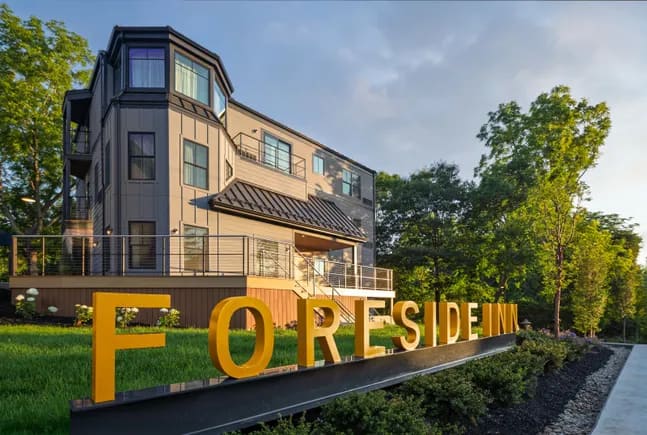
The Foreside Inn, a 24-room property opening in Kittery, Maine, next month, won't have anyone standing behind a reception desk. Instead, guests arriving at the coastal hotel will receive a randomly generated PIN code before arrival, giving them access to the building and their room for the duration of their stay.
The model relies on mobile key technology from Goki, an Australia-based provider, paired with property management software from Mews that connects booking, billing, and operations. Security cameras monitor common areas, and a four-person remote concierge team, supported by the AI platform Akia, handles guest requests around the clock via phone or text.
On checkout day, guests receive a text link to settle their bill. No line, no waiting for the elevator while juggling luggage and a key card.
Christina Lehmann, the hotel's general manager, describes it as an attempt to strip away the small annoyances that pile up during a typical hotel stay. But the shift is as much about economics as it is about convenience.
The Cost Case
Property owner Taylor McMaster estimates the lean staffing model will save the Foreside Inn roughly $200,000 annually compared to a traditionally staffed property of the same size. On-site staff includes housekeepers, a general manager, and a marketing manager. The remote concierge team, meanwhile, handles multiple properties at once. The same four-person team that supports the Foreside Inn also manages guest requests for the 18-room Rockport House in Rockport, Massachusetts, which Lehmann also oversees.
McMaster frames the approach as a natural extension of the remote-work shift accelerated by the pandemic. Technology in 2026, he argues, makes it possible to deliver front-desk services without the physical desk. The model allows staff to respond to guest needs across properties, scaling up or down depending on demand.
He's quick to note that the approach wouldn't work for a 100-room hotel, where overhead would climb too steeply. But for smaller properties, the savings can be redirected elsewhere. At the Foreside Inn, that means investing in location, design, and in-room finishes like high-end bathroom products and premium mattresses. During peak season, rooms start at $199 per night, well below the $300 typical of other hotels in the area, according to Lehmann.
McMaster insists the model isn't just about trimming costs. It's about redistributing them in ways that guests can see and feel.
What Gets Lost, What Remains
The obvious question is whether something essential gets stripped away when you remove the human presence at check-in. Lehmann says hospitality doesn't disappear; it just moves.
If a guest mentions in their booking that they're celebrating a birthday, the concierge team can send a text greeting and leave a card in the room. When a young family at the Rockport House forgot an essential item for their newborn, Lehmann arranged a Walmart delivery remotely. The gestures are small, but they suggest that attentiveness doesn't require physical proximity.
Still, the model demands tight coordination. Lehmann, who manages both properties, says staying on top of projects and communication across on-site and remote teams is critical. Without that discipline, the system falls apart.
A Template for Small Properties
The Foreside Inn isn't the first hotel to experiment with contactless check-in or remote support, but its approach is more comprehensive than the self-service kiosks that have become common in larger chains. The question is whether the model can scale beyond a handful of boutique properties.
For small hotel owners facing rising labor costs and thin margins, the appeal is clear. A remote concierge team that can manage multiple properties simultaneously offers flexibility that a single on-site receptionist can't. But the model also requires upfront investment in technology and a willingness to rethink what a hotel lobby is for.
The Foreside Inn's lobby, for instance, isn't empty. It's designed as a social space rather than a transactional one. Guests can linger, but they don't need to stop there first.
Whether travelers will embrace the shift depends partly on expectations. Younger guests who are already accustomed to unlocking rental apartments with their phones may find the approach intuitive. Older travelers, or those who value the reassurance of a visible staff presence, might feel differently.
The Broader Shift
The Foreside Inn's model reflects a broader recalibration happening across the lodging industry. Labor shortages, rising wages, and changing guest preferences have pushed operators to rethink which roles need to be on-site and which can be handled remotely or automated.
For boutique properties especially, the math is shifting. A 24-room hotel can't always justify the payroll of a full-time front-desk staff, particularly during off-peak periods. Remote concierge services offer a way to maintain responsiveness without the fixed cost.
But the model also raises questions about what gets standardized and what gets personalized. A text message wishing someone a happy birthday is thoughtful, but it's not the same as a spontaneous conversation with a local staff member who knows the best place to get coffee down the street.
McMaster believes the trade-off is worth it. By cutting overhead, the hotel can offer lower rates and invest in tangible upgrades. Lehmann echoes the sentiment, emphasizing that the goal is to make the experience easier, not impersonal.
Time will tell whether guests agree. The Foreside Inn opens August 1, and its success or failure will offer a clearer picture of whether small hotels can thrive without the front desk.