The Quiet Shift
For decades, Umbria played understudy to its more famous neighbor. Tuscany commanded the stage with its postcard hills and villa rentals, while this forested region to the east drew mostly Italians who understood what the rest of the world overlooked: the same medieval architecture and vineyard-stitched landscapes, minus the tour buses.
That dynamic is shifting. A handful of new and reimagined properties have opened across Umbria's countryside in recent years, each staking a claim on travelers looking for authenticity over brand recognition. The big international hotel groups have largely stayed away, which means the region's lodging still feels rooted in local tradition, from garden-sourced menus to service that prioritizes warmth over polish.
The appeal is straightforward. Umbria delivers the visual language of central Italy without the density. Rolling green hills, olive groves, stone hill towns perched on ridges. But the crowds that clog Tuscan roads in high season thin out here, and prices follow suit.
What Draws People
Umbria holds a particular place in Italian identity. It is the birthplace of St. Francis, patron saint of the country, and home to Assisi, one of the most visited pilgrimage sites in Europe. The region also houses the headquarters of Brunello Cucinelli, the cashmere empire, in the village of Solomeo, where an outlet store attracts shoppers willing to make the detour.
The landscape itself is a draw. Dense forests blanket much of the interior, creating ideal conditions for truffles. Black winter truffles are harvested from November through March, and truffle hunting with trained dogs has become a standard activity at countryside hotels. The ingredient shows up in nearly every kitchen, shaved over pasta or folded into scrambled eggs at breakfast.
Access has improved. Perugia, the regional capital, receives direct flights from London Heathrow and Stansted. Driving from Florence takes under two hours, making Umbria a manageable add-on for travelers already planning time in Tuscany or Rome.
The New Wave of Properties
The Monteleone, which opened recently in the Terni province, represents the current aesthetic. Seventeen rooms spread across restored stone outbuildings, minimalist interiors, a pool edged with grass rather than tile. Chef Pina prepares dishes that lean heavily on local ingredients: zucchini and cheese breads at breakfast, Umbrian classics at aperitivo. Guests can arrange truffle hunts or tastings at nearby biodynamic wineries. The medieval hill town of Monteleone d'Orvieto sits ten minutes away on foot. Rooms start around £160 per night.
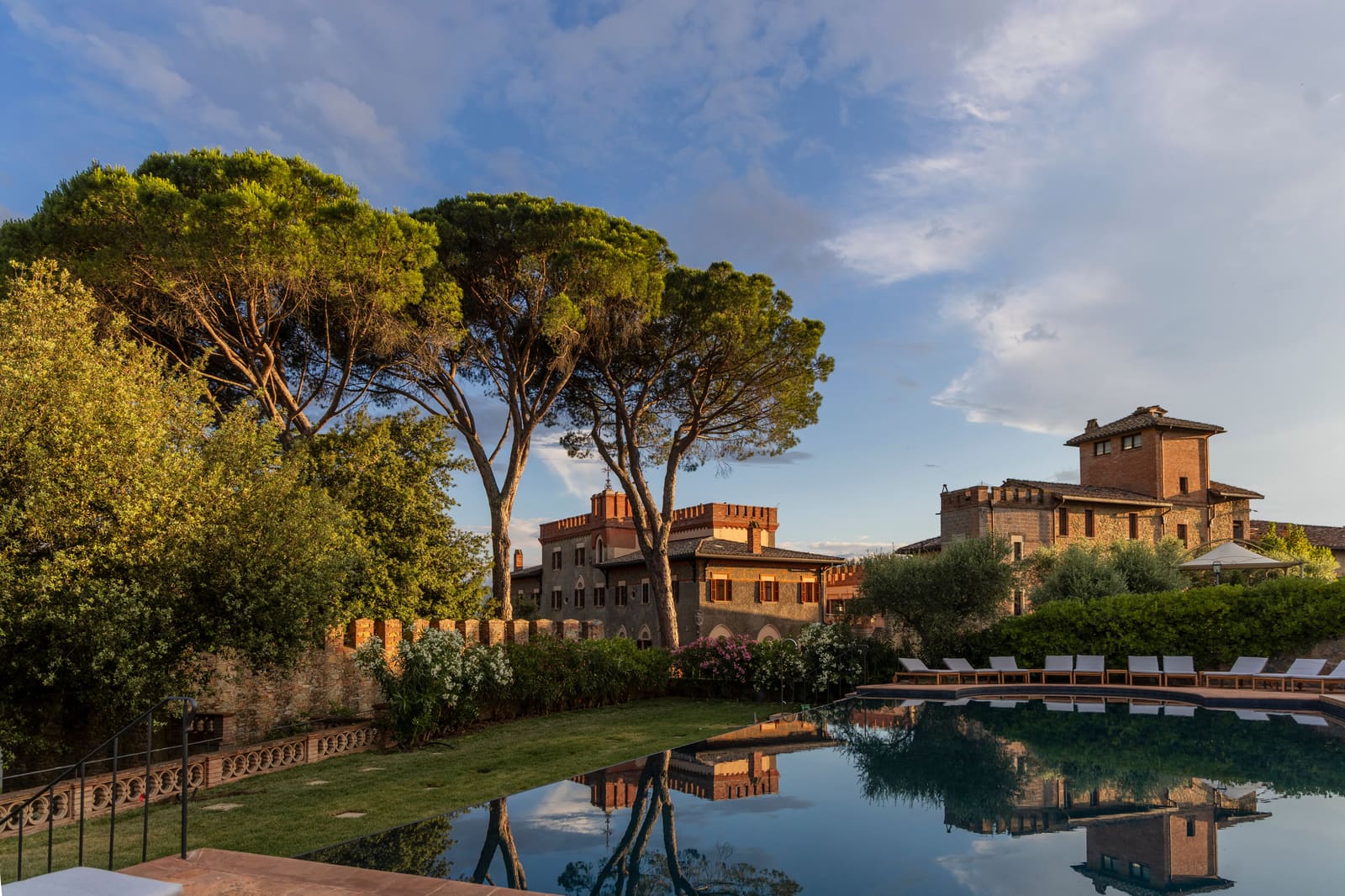
Borgo dei Conti Resort, located between Perugia and Città della Pieve, completed a full redesign in July 2024. The refresh drew color inspiration from Renaissance painters Perugino and Raphael, both connected to Umbria. Original frescoes remain, paired with materials sourced from regional artisans: terracotta tiles, bedheads woven on Perugian handlooms. An infinity pool anchors the summer experience, while forest trails and a sprawling spa extend the appeal into cooler months. The resort operates seasonally, April through November. Rooms from £750.
Rastrello, near the village of Panicale, takes its name from the small rake used in hand-harvesting olives. Owner Christiane Wassmann's family has lived in the area for over 25 years, and the property produces its own extra virgin olive oil, which appears on every dinner table and in some cocktails. The seven rooms, soon to expand to 14, are larger than typical European hotel rooms, with furnishings from local craftspeople and restored ceiling beams. Restaurant Cucina & Giardino emphasizes vegetables, much of it grown on-site or sourced nearby. Occasional Spaghettata dinners feature recipes collected from local grandmothers and grandfathers. Rooms from £300.
Vocabolo Moscatelli occupies a former monastery on a 2.5-acre estate. Twelve rooms pair ancient stone walls with contemporary art and custom-made beds from fourth-generation ironsmith Emanuele Lispi. The restaurant brings Middle Eastern and Asian influences to a region known for traditional cooking, offering dishes like ramen in Umbrian beef broth with smoked duck breast. The property doubles as a community hub, drawing locals and expatriates for cocktails and Sunday lunch. Rooms from £590.
Castello di Reschio is the outlier in scale. The 11th-century castle, set on 3,700 acres of rolling hills, olive groves, and forest, opened as a 36-room hotel in 2021 after centuries as a fortress. Owner-proprietors Count Benedikt Bolza, an architect, and his wife, Donna Nencia Corsini, an artist, shaped the redesign. The result is a mix of restored historical elements and contemporary design: a palm-court bar, an extensive spa, a swimming pool that commands views across the estate. Rooms from £950.
The Trade-Offs
Umbria's appeal rests partly on what it lacks. No major hotel chains have entered the market yet, which preserves a certain character but also means fewer options for travelers seeking predictable amenities or loyalty points. The region's hotels skew small and independent, which translates to limited availability during peak periods.
The countryside setting requires a car for most visitors. Public transportation exists but remains thin outside Perugia and a few larger towns. Driving narrow rural roads in unfamiliar territory tests patience, especially in summer when Italian families fill the region for holiday.
Prices at the higher end rival or exceed comparable Tuscan properties, particularly at estates like Castello di Reschio. The value proposition hinges on exclusivity and design rather than cost savings.
What This Means for Travelers
Umbria offers a tested formula: central Italian landscape and culture, with breathing room. The recent wave of hotel openings provides more entry points for international visitors, each with a distinct approach. Some lean minimal and modern, others emphasize artisan tradition, a few go maximalist with historical grandeur.
The region works best for travelers who want countryside immersion without sacrificing comfort, who value small-scale hospitality over resort-scale facilities, and who are willing to navigate rural roads to reach their destination. It is not a replacement for Tuscany so much as a parallel option, one that trades name recognition for a quieter experience.
As more travelers discover the region, that quietness may not last. For now, Umbria remains a step removed from the well-worn Italian itinerary, a place where the rhythm still feels local and the hills stay green without the crowds.