A Record Year, Then a Sharp Brake
Airports worldwide processed 9.8 billion passengers in 2025, marking the highest annual total on record, according to data from Airports Council International (ACI) World. The figure, published on 23 September, draws on traffic from 2,817 commercial airports across more than 185 countries and territories, covering an estimated 97 per cent of scheduled passenger movements.
International travel drove most of the growth, rising 6.1 per cent year-on-year, while domestic traffic climbed just 1.7 per cent. Hartsfield-Jackson Atlanta International Airport remained the busiest globally, handling 106.3 million passengers, followed by Dubai International with 95.2 million and Tokyo Haneda with 91.7 million.
Yet by the first half of 2026, the momentum had vanished. Passenger numbers reached approximately 4.7 billion between January and June, up just 0.6 per cent on the same period a year earlier. The slowdown reflects a combination of geopolitical tension, airspace restrictions and rising operational costs, all of which have made planning and pricing more difficult for airlines and passengers alike.
Regional Divergence Widens
Almost every region posted growth in 2025. Africa led with a 9.0 per cent increase, followed by the Middle East at 6.5 per cent, Asia-Pacific at 5.1 per cent, Latin America and the Caribbean at 4.5 per cent, and Europe at 4.2 per cent. North America was the outlier, recording a 0.7 per cent decline as domestic demand softened.
The 2026 picture is far less uniform. Africa, Europe, Latin America and the Caribbean, and Asia-Pacific continued to grow, albeit more slowly, while North American traffic remained flat. The Middle East saw the steepest fall, with passenger numbers down 21 per cent as conflict and airspace closures forced airlines to reroute or cancel flights.
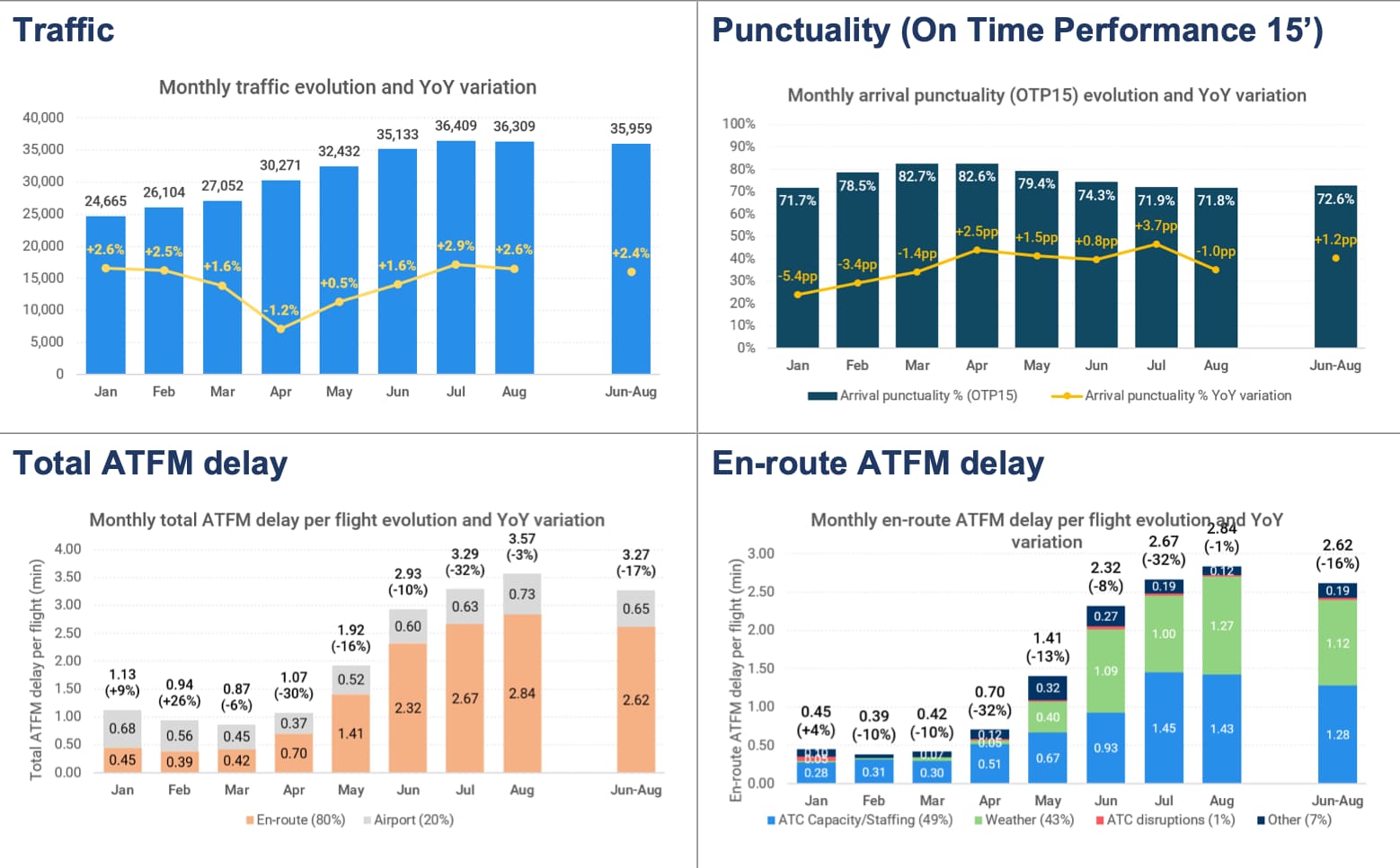
Europe, by contrast, managed its busiest summer on record. Between 1 June and 31 August 2026, the continent's aviation network handled an average of 35,959 flights per day, up 2.4 per cent on the previous summer, according to Eurocontrol. The resilience suggests that demand remains robust where infrastructure and airspace remain open, even as uncertainty weighs on other parts of the network.
Cargo and Movements Also Climbed in 2025
Passenger traffic was not the only metric to reach new highs. Global air cargo volumes increased 3.3 per cent in 2025 to 131.2 million tonnes, while aircraft movements rose 2.0 per cent to 103.1 million. The cargo figures reflect continued e-commerce demand and supply-chain adjustments, though the rate of growth has moderated from pandemic-era peaks.
Justin Erbacci, Director General of ACI World, said the 2025 results confirm that long-term demand for air travel remains strong. He argued that meeting future demand will require both expanded capacity and better use of existing infrastructure, alongside regulatory frameworks that enable rather than block investment.
Capacity Questions Loom
The sharp deceleration in 2026 raises questions about how quickly the industry can absorb demand once conditions stabilise. Many airports operated near or at capacity during peak periods in 2025, and delays in expanding runways, terminals and ground-handling facilities mean that even modest growth can strain systems.
ACI World maintains that underlying drivers of aviation demand, including population growth, rising incomes and expanding connectivity, remain intact. Yet the volatility of the past 18 months underscores how quickly external shocks can override those fundamentals, at least in the short term.
For travellers, the slowdown has translated into fewer route options in some regions, higher fares where capacity is tight, and longer connection times as airlines avoid contested airspace. For airports and airlines, it has meant navigating a more complex operating environment in which demand is present but access is not guaranteed.
The contrast between 2025's record-breaking year and 2026's near-stagnation illustrates how fragile growth can be when geopolitical and operational disruptions intersect. Whether the industry returns to steady expansion will depend on how quickly those disruptions ease and whether infrastructure investment can keep pace with the demand that, for now, remains waiting in the wings.