The Gap Is Shrinking Fast
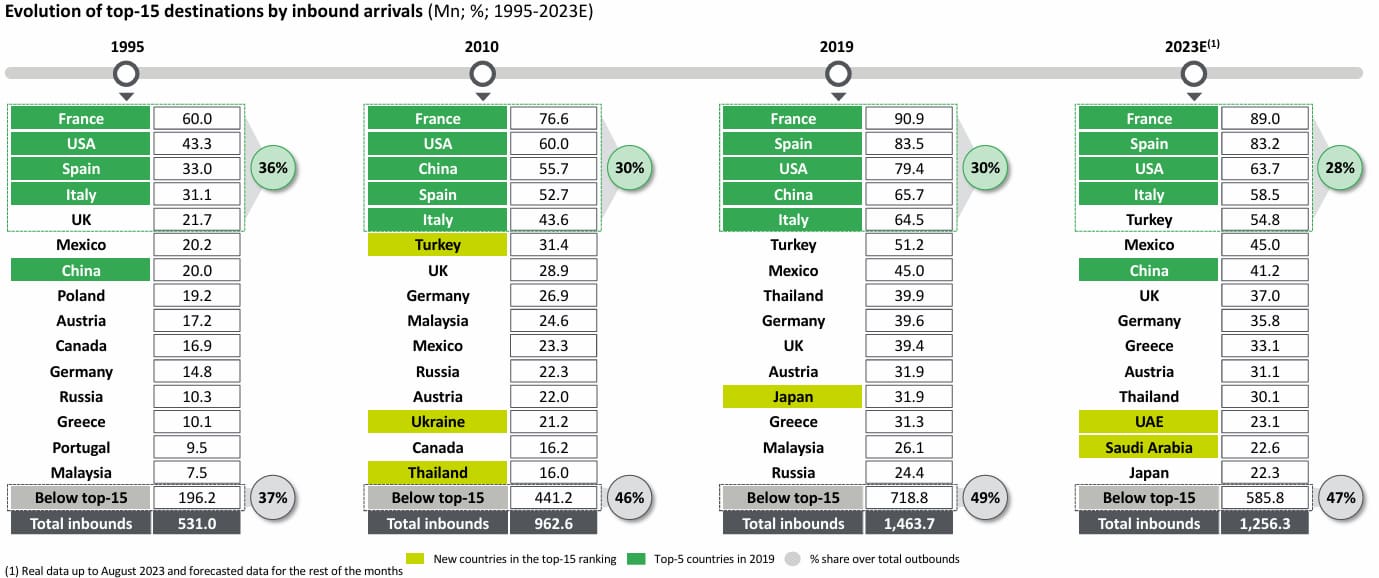
Spain recorded 96.8 million international arrivals in 2025, climbing 3.2% from the year before. That puts the country roughly five million behind France, which logged 102 million visitors the same year and has occupied the top spot for decades. Research from Deloitte and Google had predicted Spain would pull ahead around 2040, reaching approximately 110 million arrivals against France's 105 million. Yet if current momentum holds, Spain could cross the symbolic 100 million threshold as soon as next year, compressing a 14-year timeline into two.
The acceleration raises a question that moves beyond bragging rights. Spain already collected €134.7 billion from international visitors in 2025, according to official Spanish figures, far outstripping the €77.5 billion France earned despite hosting fewer guests. Visitors to Spain stay longer, spend more on accommodation and dining, and concentrate their budgets in ways that flow directly into the economy. France, meanwhile, sees shorter trips and lower per-capita spending, even as its capital anchors one of the world's most recognizable destination brands.
A Bigger Picture of Global Movement
The Deloitte and Google work models a tourism landscape that will look markedly different by mid-century. Between 1975 and 2019, international arrivals doubled roughly every 15 years, reaching nearly 1.5 billion before the pandemic interrupted that arc. The researchers expect that expansion to resume, pushing the global total to 2.4 billion trips by 2040.
Europe will capture the largest share of new demand, adding more than 362 million arrivals between 2019 and 2040, or 38% of the worldwide increase. Asia-Pacific follows with over 278 million additional visitors. Yet the concentration at the very top will ease. The five busiest countries claimed about 30% of all arrivals in 2019; by 2040 that figure is forecast to slip to around 20%. Spain, France, the United States and China are expected to hold their places near the summit, while Mexico climbs to fifth and destinations such as Saudi Arabia, Indonesia and the United Arab Emirates push into the top 15.
That diffusion reflects rising incomes across Asia, the Middle East, Latin America and parts of Africa. More people will have the money and the passport to travel, and they will look beyond the traditional circuit. The Mediterranean, Southeast Asia, emerging Gulf hubs and the Caribbean are projected to account for roughly 45% of all international trips by 2040.
Why Spain Generates More Revenue Per Visitor
Part of the answer lies in length of stay. International guests in Spain often book week-long beach holidays, city breaks that stretch across long weekends, or multi-region itineraries that string together Barcelona, Madrid, Seville and an island stop. French arrivals, by contrast, include large numbers of same-day or overnight visitors from neighboring countries, business travelers passing through Paris, and tourists who spend a night or two before moving on. Shorter stays mean less spending on hotels, meals and activities.
Spain's tourism geography also plays a role. The Canary and Balearic Islands draw sun-seekers year-round, the Mediterranean coast offers resort infrastructure at scale, and cities such as Valencia, Málaga and Bilbao have built reputations that pull visitors beyond the usual Madrid-Barcelona axis. Rural areas in the north, wine regions inland and cultural routes through Andalusia add depth. France has comparable variety, from Alpine ski stations to Atlantic beaches and wine country, but its model has historically prioritized volume and throughput rather than maximizing revenue per head.
Both governments are now pivoting. French tourism authorities aim to lift international receipts to €100 billion by 2030 while branding the country as a leader in sustainable travel. Spain's Tourism Minister, Jordi Hereu, has called for "calm growth," spreading visitors across seasons and regions instead of funneling ever-larger crowds into the same hotspots. The shift acknowledges a reality that raw arrival numbers no longer tell the full story.
The Overtourism Reckoning
Spain's rise brings a paradox. Hitting 110 million arrivals would be a commercial triumph, yet it would also intensify pressure on communities already stretched thin. Anti-tourism protests have flared in Barcelona, the Canary Islands and the Balearics, driven by housing shortages, short-term rental saturation, congestion and a sense that residents shoulder the downsides while corporate operators capture the profits.
Policy responses have come in waves. The national government has ordered tens of thousands of properties removed from the tourist-accommodation register for failing to meet licensing standards. Barcelona plans to eliminate licences for roughly 10,000 short-term apartments by 2028, effectively zeroing out its legal holiday-rental stock under current rules. Cruise arrivals face tighter caps in several ports, the Balearics have cracked down on party boats and alcohol-fueled tourism, and Málaga has launched campaigns urging visitors to keep noise down and respect local life.
These measures reflect a deeper tension. Another 10 or 15 million tourists represent billions in national economic output, but at street level they can translate into higher rents, crowded buses, overrun beaches and strained water supplies. Becoming the most-visited country in the world means little if the volume erodes the culture, landscape and quality of life that made people want to come in the first place.
France Is Not Standing Still
It would be premature to treat Spain's ascent as a foregone conclusion. Forecasts that stretch to 2040 rest on assumptions about economic growth, geopolitical stability, climate patterns, aviation capacity and the expansion of the global middle class. Any of those variables can shift.
France also holds structural advantages. Paris remains one of the planet's most powerful destination brands, but the country's appeal extends well beyond the capital. The Alps draw winter sports enthusiasts, the Mediterranean coast competes with Spain for beach traffic, wine regions attract oenophiles, and villages scattered across Provence, Brittany and the Loire Valley offer heritage and charm at a human scale. An extensive rail network makes multi-city travel straightforward, and a deep well of cultural and gastronomic assets gives visitors reasons to return.
France welcomed 102 million arrivals in 2025 and needs only modest annual increases to reach 105 million by 2040. Spain, starting from 96.8 million, would need to add roughly 13 million more. In percentage terms, neither target looks especially aggressive. The real question is not whether either country hits its number, but what kind of tourism they are building along the way.
What Success Actually Looks Like
For decades, tourism league tables have rewarded volume. The country with the most border crossings claims the top spot, generates headlines and enjoys diplomatic prestige. But that metric is increasingly hollow. Spain already earns more from fewer visitors than France does from more. Both are trying to lift revenue while easing congestion, distributing demand across geography and calendar, and protecting the quality of life for people who live in tourist zones.
The global tourism market is on track to add roughly 900 million international trips between now and 2040, driven largely by new travelers from Asia, the Middle East, Latin America and Africa. That wave represents an enormous economic opportunity for Europe, but it also means that destinations already dealing with capacity pressure cannot simply assume that absorbing more people is the goal.
Spain may well become the world's most-visited country by 2040, or even by 2030 if current trends hold. France may find ways to stay ahead. Either way, the more meaningful test will be whether Europe's two tourism heavyweights can show that record demand and livable cities, protected coastlines and resilient communities can exist in the same place at the same time. The number on the scoreboard matters less than what happens underneath it.