A Different Booking Model
Most wellness hotels expect you for a weekend. The Pasona Natureverse Retreat, which opened recently on Awaji Island in Japan, sets a three-night minimum and designs its programmes around longer visits. The property centres on Mibyo, a Japanese concept of preventive wellness that treats health as a continuum rather than a binary state of sick or well.
The approach reflects a broader conversation in wellness travel about whether short escapes deliver lasting benefit or simply punctuate stress. By enforcing a longer stay, the retreat signals that the work of recalibration takes time.
Guests can book the minimum three nights, but the property tailors its offerings to those planning a week or more. Programmes include thalassotherapy, movement classes, yoga, meditation, and access to private onsen baths fed by natural hot springs. The menu leans toward what the hotel calls nourishing rather than indulgent, a subtle shift in language that hints at the philosophy underneath.
Shigeru Ban's Third Project on the Island
The 57-room building was designed by Shigeru Ban, the Pritzker laureate known for his use of recycled and natural materials. Ban won the Pritzker Prize in 2014 and received the AIA Gold Medal in 2026. His previous work on Awaji includes a restaurant for Pasona Group and a meditation retreat called Zenbo Seinei.
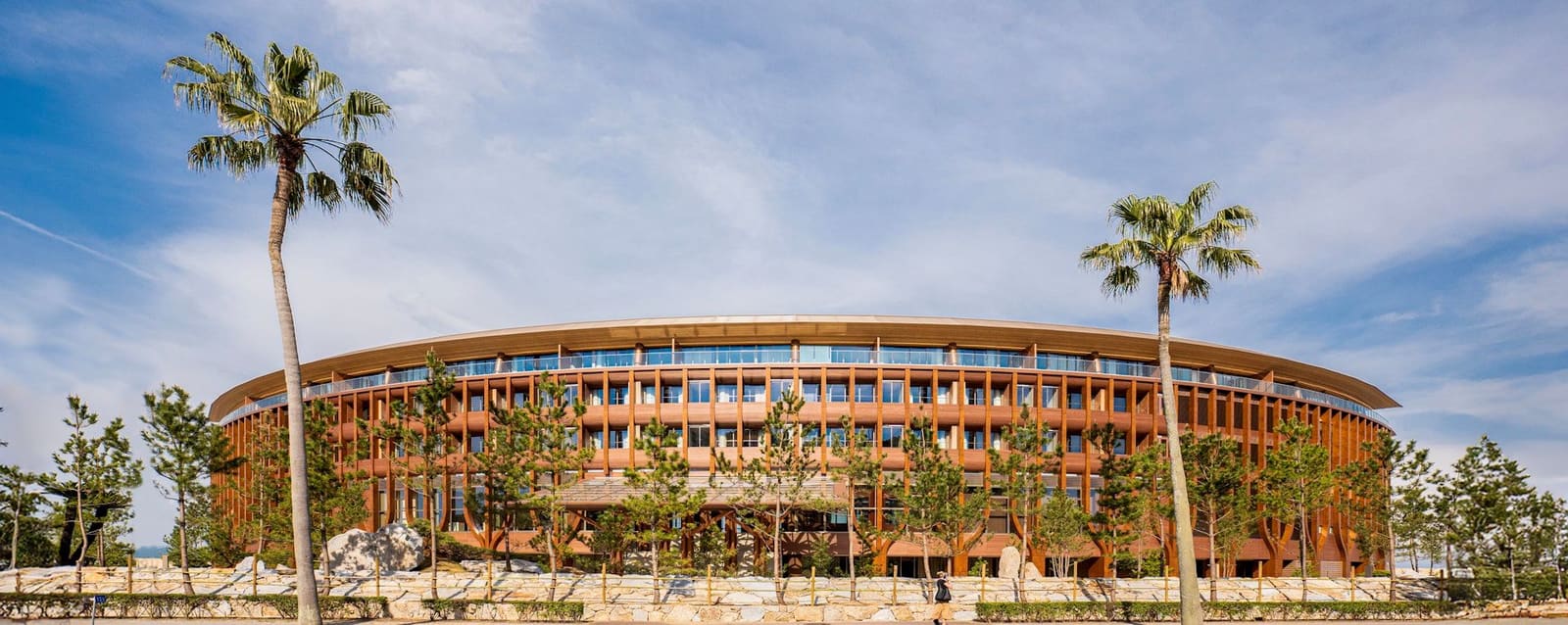
The Pasona Natureverse Retreat is his third commission in the area, and the design reflects his ongoing interest in how buildings relate to landscape. The structure rises five storeys and wraps around a skylit atrium in a D-shape. Every room faces either forest or sea, depending on which side of the curve it occupies.
On the inland side, vertical wooden cladding runs the height of the facade, and windows look into dense greenery. The seaside elevation reverses the emphasis. Here, horizontal slabs stack across four levels, with generous balconies that extend living space outward. The transparency on this side blurs the line between interior and coast.
Ban describes the seaside facade as creating continuity between inside, outside, and scenery. The mountain-facing side, by contrast, uses a rhythm of timber columns that he calls classical in its verticality. At the centre of the building, a large timber canopy shelters a grand staircase that serves as the main entrance.
What the Building Offers
Beyond the rooms, the retreat includes an aerial yoga studio, an indoor saltwater pool, five restaurants, and multiple cafes. The culinary programme is part of the wellness structure rather than separate from it, with menus designed to support the longer-term health goals that Mibyo emphasises.
Each room comes with either a private onsen or access to shared hot spring facilities. The atrium layout ensures natural light reaches deep into the building, a design choice that supports circadian rhythm and mood, both of which matter more on extended stays.
The property also offers personalised wellness programmes, though details on how these are structured or what qualifications the practitioners hold remain sparse. That opacity is common in wellness hospitality, where the line between therapeutic and experiential can be hard to draw.
Pricing and Accessibility
Rooms start at roughly 2,300 euros per night for a double, which places the retreat firmly in the luxury segment. At that rate, a minimum three-night stay exceeds 6,900 euros before meals, treatments, or programming. The price point raises questions about who can access this model of preventive wellness and whether the philosophy can scale beyond high-end hospitality.
Awaji Island sits in the Seto Inland Sea between Honshu and Shikoku, connected to Kobe by bridge. The location is accessible but not urban, a balance that appeals to travellers seeking proximity without immersion in a city. The island has become a testing ground for wellness concepts, in part because of Pasona Group's investment in the area.
The Case for Slowing Down
The retreat's structure challenges the weekend-escape model that dominates wellness travel. Whether three nights is enough to shift habits or simply a marketing threshold is an open question. Research on behaviour change suggests that meaningful shifts require consistency over weeks, not days, which would argue for even longer stays.
Still, the minimum represents a step toward aligning hospitality design with the stated goals of wellness. If the aim is prevention rather than pampering, the model has to change. The Pasona Natureverse Retreat tests one version of that change, anchored by architecture that asks guests to notice where they are and how long they plan to stay.